Overview


Overview
This project details a small & simple, but very powerful USB charger for your mp3 player, camera, cell phone, and just about any other gadget you can plug into a USB port to charge! (See below for compatibility tests.)The charger circuitry and 2 AA batteries fit into an Altoids gum tin, and will run your iPod for hours! 2.5x more than you'd get from a 9V USB charger! (See Process for math/calculations) You can use rechargable batteries too.
Specifications:
- Version 3 now works with iPhones and newer iGadgets!
- 5V output @ 500mA output
- Fits in your pocket
- Recharges just about any gadget with a USB cable
- Uses any AA batteries!
- Upgrade to C or D cells for a mega battery pack
- iPhone (all types): 3/4 full recharge
- iPod video (tested, using alkaline batteries): 3hrs more video (1 full recharge)
- iPod mini (tested w/rechargables): 26 hours more (1.5 full recharges)
- iPod nano: 4 full recharges!
- iPod shuffle : 60 hours more , 5 full recharges!
I've also documented the process of designing this kit, in case other people interested in designing and making kits are interested in learning how to start selling their own kits!


This website and all original content therein is published under the Creative Commons 2.5 attribution license.
Reviews & Gallery
Read what some people have to say! (And let me know if you have a review you'd like linked to from here)
- Paul Stamatiou's review
- Jim Wandering's review
- Daniel Beck's review
- The Samurai's gallery
- Erike built one for his sweetheart
- Bean tooth made a cherry flavored one
- Piet in Finland uses his for watching long videos
- Lexiredlion built 5!
Device Compatibility
Hey we moved this really long list to the user manual, please go there to see compatibility charts for versions 2 and 3 of the mintyboost!
Mintyboost® is a registered trademark of Adafruit Industries
Page last edited March 11, 2013
Text editor powered by tinymce.
F.A.Q.
Frequently Asked Questions
It works! But then the iPod/iPhone/device gets drained...what's up?
This is a common problem with iPods/iPhone/iTouch. These devices have very large batteries and they have an annoying bug that if they -think- they're being charged they'll stay on and not 'go to sleep' conserving power. That means that if the AA batteries die before the device is done charging, the device will stay on at full power because it thinks it is plugged into the wall. This can cause it to drain the battery. The best suggestion is to use fresh/charged batteries and don't leave it plugged in overnight.This is especially true of iPhones, as they suck out all the battery power in a little less than an hour in order to 'quick charge'. This reduces the capacity of the batteries, but means that your phone will be up and running faster.
Once you see the charging icon change from a plug, the mintyboost is 'dead' and you must unplug it. For more information, see the user manual.
How come my iPhone/iTouch doesn't completely charge?
iPhone/iTouch's have batteries that are so large there is no way to fully charge them on 2 AA's. You can only charge 1/2 of a battery because the AA's will die before finishing. You should use the Mintyboost to 'boost' it, but not as a way to fill the whole battery to full.Will the MintyBoost charge my device?
Very likely! Check out our compatibility lists for more information about your favvy gadget. If you find a new device that it does/doesn't work with, please post on the forum or contact us (thanks!)Nearly all USB-charging devices and any device that charges with 5V power (up to 500mA+ with v2 or v3 of the kit) can be used.
If you are having problems with your device, see the other FAQ's below.
ARRGH! It doesn't work!
Don't panic! Post to the forum (don't send email) about your problem.A high resolution photo of the top and bottom of your kit will be extremely helpful in debugging your problem.
I get the right voltages but it doesn't charge my favorite gadget! Is the kit a "USB Specification" Charger? If not, how can I make it into one?
Some devices will only charge from 'dedicated USB spec' charger. You may want to convert your Mintyboost to a 'USB spec' charger, which is very simple to do, follow the instructions here on how to do it. This mod will work on any MintyBoost version (v1 v2 or v3) Then try again!Can I buy a pre-made/pre-built MintyBoost?
We don't sell assembled MintyBoosts, only kits. However, if you post on the forum, people sometimes offer to sell manufactured kits at low cost.What does the MintyBoost kit come with?
The kit comes with a PCB and all components necessary to build the kit. It does not come with an altoids tin or tools or batteries. The tin isn't necessary but MintyBoost is designed to be placed in one for protection and aesthetics.How many charges/hours of use can I get out of a MintyBoost?
This question is hard to judge because every device has different power usage. However, a simple way to calculate approximate run-time is: take the size of the internal Lithium-Ion battery (for example, many iPods have 750mAh batteries) and divide 1000 by that number.So for a 750mA battery, 1000/750 = 1.3
The MintyBoost will fully charge the device about 1.3 times, as a best case.
Remember, this is only an approximation and has a lot to do with the quality of the batteries you use (expensive alkalines v. cheap rechargables) and the internal circuitry of the device for recharging the battery.
For a detailed mathematical analysis, check the user manual under "How many recharges will I get?"
I want better performance, should I attach 3 or 4 AA batteries? How about a 9V?
Check out our detailed battery power tutorial!OK but what if I want 4 AA's, 2 sets of 2 in parallel?
Check out our detailed battery power tutorial!When I use the kit, the chip/batteries seems warm or hot...Is this OK?
It's normal for the chip and batteries to be warm or hot, especially when charging a device that is nearly drained. The chip should not get hot or very warm when nothing is plugged in.The maximum temperature for the mintyboost chip is over 100 degrees C, that is hotter than boiling water. If you are worried, lick your finger (a little) and touch the tip of your finger to the top of the LT1302 chip. If you don't hear a sizzle (of the water boiling away), it's just fine.
However, if the batteries are so hot that its painful to touch, start to smoke, burn or melt or leak fluid....something is wrong! Unplug it immediately and remove the batteries if it is safe to do so.
But it's really hot and I'm worried!
Yes, this is normal. When the chip is working to charge your gadget, it's going to get hot. Normally you never get to see or touch the chips in your chargers so you don't realize how hot electronics get.Really, it's normal for the Mintyboost to get hot!
If you're concerned, you can always do the finger test above. If it's too hot, it will sizzle, otherwise, it's OK.
When I plug in a device, sometimes theres a 'hum', 'hiss', 'squeak', 'whine', etc noise...is this normal?
Yes, sometimes the inductor resonates with the boost converter and that resonance leaks into the audible range. While it's not good for it to always vibrate, it does happen occasionally and is not harmful to the charging device. you can try moving the inductor a little with your finger but the noise is electrical in nature so it's hard to stop completely.Another thing is that it depends on how much power the device is drawing and what kind of batteries are inside.
If this is a charger, why are the data (D+ and D-) lines used? Why doesn't the 3Gs work with the Mintyboost v2, but the older iPhone does? What are the pullup/down resistors used for, and which should I use?
We have a full tutorial all about Apple gadget charging, check it out!
Does the v1.x work with iPhone/iTouch? Does the v2.0?
Version 2.0 pretty much works with iPhones/iTouch devices but the v1.0 cannot because it is not powerful enough. To get it working you will need the LT1302-5 which can provide 500mA (compared to 200mA from the MAX756).We have a full tutorial all about Apple gadget charging, check it out!
Can I convert a v1.x kit to a v2.x? Can I use a MAX756 in a v2.x or a LT1302-5 in a v1.x?
No, they are completely different designs requiring new PCBs are components, they are not drop-in replaceable at all.Why doesn't the v1.2 kit come with R1-R3 and LED1
These parts are optional: they are for the low battery indicator. There wasn't enough space to add them to the PCB using through hole parts so they are surfacemount and on the bottom. They're an 'extra' capability which you may add if you feel experienced with SMT soldering.I'm trying to make/breadboard this kit on my own and it's not working! HELP ME!
It is pretty much impossible to get good ouput from the kit if it is breadboarded. A custom PCB or proper perf-board is essential. Most components cannot be swapped, and must be used as indicated, even if they're difficult to find in your area. All documentation is on the site.I can't provide any support or help to 'DIYer's because of the time and difficulty in debugging these projects. Please endeavor to work out your project on your own.
Do you have any high rez photos?
Try:- "Standard issue" iPod charging photo
- PSP
- Wave Bubble
- Shuffle 2G
- Nano 1G
- Dell Mp3 player
- Video iPod
- Photo iPod
Mintyboost® is a registered trademark of Adafruit Industries
Page last edited March 11, 2013
Text editor powered by tinymce.
Make it!
Make your own
Make it!
This is a vey easy kit to make, just go through each of these steps to build the kit:- Tools and preparation
- Check the parts list
- Solder it (Instructions for version 3.0 kits only!)
- Put it in a case
Older soldering instructions!
If you have an older Mintyboost (or just interested in photos of soldering), here you go!Mintyboost® is a registered trademark of Adafruit Industries
Page last edited March 11, 2013
Text editor powered by tinymce.
Preparation
Don't forget to learn how to use your multimeter too!
Tools
There are a few tools that are required for assembly. None of these tools are included. If you don't have them, now would be a good time to borrow or purchase them. They are very very handy whenever assembling/fixing/modifying electronic devices! I provide links to buy them, but of course, you should get them whereever is most convenient/inexpensive. Many of these parts are available in a place like Radio Shack or other (higher quality) DIY electronics stores.

Any entry level 'all-in-one' soldering iron that you might find at your local hardware store should work. As with most things in life, you get what you pay for.
Upgrading to a higher end soldering iron setup, like the Hakko FX-888 that we stock in our store, will make soldering fun and easy.
Do not use a "ColdHeat" soldering iron! They are not suitable for delicate electronics work and can damage the kit (see here).
Click here to buy our entry level adjustable 30W 110V soldering iron.
Click here to upgrade to a Genuine Hakko FX-888 adjustable temperature soldering iron.

You will want rosin core, 60/40 solder. Good solder is a good thing. Bad solder leads to bridging and cold solder joints which can be tough to find.
Click here to buy a spool of leaded solder (recommended for beginners).
Click here to buy a spool of lead-free solder.


You will need a good quality basic multimeter that can measure voltage and continuity.
Click here to buy a basic multimeter.
Click here to buy a top of the line multimeter.
Click here to buy a pocket multimeter.

You will need flush diagonal cutters to trim the wires and leads off of components once you have soldered them in place.
Click here to buy our favorite cutters.
An alternative to diagonal cutters could be tin snips but they often are larger and lack precision.

Strangely enough, that's the technical term for this desoldering vacuum tool. Useful in cleaning up mistakes, every electrical engineer has one of these on their desk.
Click here to buy a one.

Not absolutely necessary but will make things go much much faster, and it will make soldering much easier.
Pick one up here.
Page last edited March 11, 2013
Text editor powered by tinymce.
Parts list
Check your kit!
Check to make sure your kit comes with the following parts. Sometimes we make mistakes so double check everything and email [email protected] if you need replacements!Note that the parts list is slightly different depending on whether it is the latest v3.0 kit, older v2.0 or ancient v1.2 kit. Check the kit packaging to determine which version you have! If you have an older version, scroll down to find your parts list!
Also note that Altoids has discontinued their gum. We have identically sized tins in the store now.
Parts list for v3.0
| Image | Name | Description | Distributor | Qty |
|---|---|---|---|---|
|
|
IC1 | 5V boost converter LT1302CN8-5 (for v2.0 and V3.0) |
Newark Linear |
1 |
|
IC1' | 8-pin socket | Generic | 1 |
|
C4, C3 |
Power supply capacitor 220uF/6.3V+ |
Generic | 2 |
|
C1, C2 | Bypass capacitor (0.1uF) | Ceramic Capacitor | 2 |
|
R5 |
1/8W 5% 3.3K resistor This part was added in version 3.0. If you don't have one you may have a version 2.0 kit! |
Generic | 1 |
|
R2, R4 |
1/8W 1% 75K resistor This part may also appear as a Brown-body 7502F DALE resistor This part was added in version 3.0. If you don't have one you may have a version 2.0 kit! |
2 | |
|
R1, R3 |
1/8W 1% 49.9K resistor This part was added in version 3.0. If you don't have one you may have a version 2.0 kit! |
2 | |
|
D1 | 1N5818 (or 1N5817, etc) Schottky Diode | 1N5818 | 1 |
|
L1 | 10uH power inductor, at least 1A current capability | RLB9012-10 | 1 |
|
X1 | USB type A female jack | Generic | 1 |
|
2 x AA battery holder | Keystone 2463 | 1 | |
|
PCB | Circuit board | Adafruit Industries | 1 |


| Image | Name | Description | Distributor | Qty |
|---|---|---|---|---|
|
IC1 | 5V boost converter
LT1302CN8-5 (for v2.0) |
Newark Linear |
1 |
|
IC1' | 8-pin socket | Generic | 1 |
|
C4, C3 | Power supply capacitor
220uF/6.3V+ |
Generic | 2 |
|
C1, C2 | Bypass capacitor (0.1uF) | Ceramic Capacitor | 2 |
|
R4, R5 |
15K 1/4W 5% resistor (brown green orange gold) These were included for older iPods and devices. |
Generic | 2 |
|
100K 1/4W 5% resistor (brown black yellow gold) Alternatives for R4/R5 for the latest iPods (classic, nano video) |
Generic | 2 | |
|
D1 | 1N5818 (or 1N5817, etc) Schottky Diode | 1N5818 | 1 |
|
L1 | 10uH power inductor, at least 1A current capability | RLB9012-10 | 1 |
|
X1 | USB type A female jack | Generic | 1 |
|
2 x AA battery holder | Keystone 2463 | 1 | |
|
PCB | Circuit board | Adafruit Industries | 1 |


Parts list for v1.2
This is the parts list for the quite-old-now V1.0 to v1.2 mintyboosts.| Image | Name | Description | Distributor | Qty |
|---|---|---|---|---|
|
IC1 | 5V boost converter
MAX756-CPA (for v1.2) |
Digikey Maxim |
1 |
|
IC1' | 8-pin socket | Generic | 1 |
|
C4, C3 |
Power supply capacitor 100uF/6.3V or higher |
Generic | 2 |
|
C1, C2 | Bypass capacitor (0.1uF) | Ceramic Capacitor | 2 |
|
R4, R5 |
15K 1/4W 5% resistor (brown green orange gold) These were included for older iPods and devices. |
Generic | 2 |
|
100K 1/4W 5% resistor (brown black yellow gold) Alternatives for R4/R5 for the latest iPods (classic, nano video) |
Generic | 2 | |
|
D1 | 1N5818 (or 1N5817, etc) Schottky Diode | 1N5818 | 1 |
|
L1 | 10-22uH power inductor, at least 1A current capability | RLB9012-10 | 1 |
|
X1 | USB type A female jack | Generic | 1 |
|
2 x AA battery holder | Keystone 2463 | 1 | |
|
PCB | Circuit board | Adafruit Industries | 1 |


R5 should be installed as either a pulldown or pullup (like R4) - in the V1.2 pcb there are two positions possible
Mintyboost® is a registered trademark of Adafruit Industries
Page last edited March 11, 2013
Text editor powered by tinymce.
Solder it
Instructions for Version 3.0
These are the instructions for v3.0, if you have an older mintyboost you may want to check out the specific instructions for earlier versions.Solder It!
The first step is to solder the kit together. If you've never soldered before, check the Preparation page for tutorials and more.
Most importantly, check which version of the kit you have. Look at the packaging, and the PCB - find that v3 thats on the back near the top!

If you don't know how to solder, we suggest checking out the videos in the link above. They're quite good! Keep them in a window so you can watch and review as you work through the kit

Resistors are non-polar which means they don't have a direction: you don't have to worry about putting it in 'backwards' because they work the same either way.


Now you'll solder! Place the flat of the soldering iron tip against the silver ring (pad) and one of the wires of the resistor (lead) at the same time for 2 seconds. This will heat them both up to 600-700 degrees. Then poke the end of the solder so that it flows into the hole and forms a solder joint.
Solder joints should be smooth and shiny and fill the entire pad, wicking up to the lead. You shouldn't be able to wiggle the wire and have it move in the hole.


These resistors are blue and have the following stripe colors: Violet Green Black Red Brown. They're very small and easy to confuse with the other blue resistors, but the other resistors have white and yellow stripes so perhaps look and make sure your resistors don't have any light stripes on them?
You might also have brown 7502F DALE resistors that are a little larger, in this case you can double the resistor over like this and solder it in the same spot. They wont sit flat but thats alright!
These resistors are used by Apple iPhones and such to determine what kind of charger is connected.


These resistors are used by Apple iPhones and such to determine what kind of charger is connected.
Solder them in.


C1 helps stabilize the output voltage, and filters out high frequency noise so that the 5V output is nice and smooth.
Now it's time for the next capacitor, C2. This capacitor is used to stabilize the internal reference of the boost converter chip. This keeps the chip stable so that it will generate a voltage as precise as possible.
(We forgot to take a photo of placing them so we stole the next photo which also shows a black and white diode, don't place that yet...just the two yellow blobbies)


Next is the IC socket. This protects the chip and allows you to replace it if there are any problems. The socket goes over the 3.3K resistor but the resistor should not interfere as long as it was soldered in properly.
Make sure you solder the socket in so that the notch in the edge of the socket matches up with the notch in the silkscreen image of the socket. In this image it's near the bottom. If you mess this up, dont try to desolder the socket, instead just keep going and remember that it is upside down later when it's time to install the chip.


The socket has short legs so it can be annoying to keep in the right position. Hold it in place with one finger and 'tack solder' a corner.
Once that is done, solder in the remaining 7 pins. There is no need to clip.

Next is the power inductor L1. This component is used by the DC/DC converter chip to store and convert power from low voltages to high. Inductors are just a coil of wire so they have no polarity and can be placed either way.
The inductor may not sit perfectly flat, since the socket is in the way a bit. That's ok, just lean it over a little.


Next are the two electrolytic capacitors. These help smooth both the input and output voltages, to keep them stable during the up-conversion. They are used for low frequency noise, and are often paired with a ceramic capacitor.
Electrolytic capacitors are polarized and must be placed correctly or the circuit will not work. The longer lead is the positive (+) one and must go into the pad marked with a + as shown.


Next, solder in the 2xAA battery holder. The red wire goes to the hole marked + and the black wire goes to the hole marked -.
Make sure you have them in right or you can damage the circuit!


We like to put down a piece of paper to ensure there's no chance of damage. Then insert two fresh AA batteries - alkaline or rechargeable is OK.
Wait a few seconds and feel the battery and chip. Are they getting hot? If so, remove the batteries and look over your work. The kit should not even get warm!

You should get a bit higher than 4.8V but lower than 5.2V.
If you get higher than 5.2V or lower than 4.8V, first check that your multimeter has a fresh battery. Really! this is a really common problem!
If you get lower than 3V, remove the batteries and check your work.


Once you are happy with these tests, remove the batteries and finish assembling the kit!


The two large side connectors are used for mechanical strength. They keep the connector attached solidly to the PCB so make sure to use lots of solder or it will break off from use.
The four middle pins carry the power and data for USB. Solder in all four.


Remove the batteries from your kit! Then using your soldering iron, heat up the two middle USB pins at the same time and blob on a bunch of solder to short them together.
Now try again!
Page last edited March 11, 2013
Text editor powered by tinymce.
Case it


Once you're happy, remove the electronics and put the doublesided sticky foamtape on both the circuit board and the battery holder.
Remember to make sure no pin or parts or leads are sticking out and can touch the tin.
Use duct, foam or, electrical tape to protect the circuit. Clip your leads short so they dont poke through the foam. You can easily destroy the circuit by being sloppy here.


Mintyboost® is a registered trademark of Adafruit Industries
Page last edited March 11, 2013
Text editor powered by tinymce.
Use it!
Tips and tricks, how to use your MintyBoost
The MintyBoost User manual!
- How to use the Mintyboost
- Batteries! How to get the most out of your mintyboost from picking the right AA's to rechargables, to mega-capacity, and more!
- Compatibility list for the latest v3 Mintyboosts
- Compatibility list for older v2.x Mintyboosts
- The mysteries of Apple iDevice charging...revealed!
- Changes between versions of the Mintyboost
Page last edited March 11, 2013
Text editor powered by tinymce.
How to use
Basic User Manual
Go MintyBoost!
Here is a basic instructional manual that will cover pretty much everything you need to know about the mintyboost you just built.Compatibility
So, does it work with your gadget? First you can always visit our compatibility list which we keep updated. We have a list for versions 2.x of the kit and 3.x. We try to keep the list updated as much as possible - if something is not on that list then it doesn't mean it doesnt work, just that we dont know. Almost all devices charge fine!One thing you can always do is try it out! Wait until the battery is halfway drained, then plug your gadget into the USB port and wait a few minutes and see if the battery inches up or if the charging light goes on. You can also feel the mintyboost to see if it's warming up which would indicate it's providing power to the gadget.
Which batteries to use?
Basically, get the best batteries you can. New Lithium or Alkaline 1.5V batteries work great as do fully charged NiMH rechargables. Old, worn out or dead batteries will not work at all.We have a very detailed tutorial about batteries in case you want a lot of details.
How to charge
Easy, get a USB charging cable for your gadget, nearly all come with one these days, you can also usually get one for cell phones or games at an accessory shop. Plug in the USB end into your mintyboost and the other end into your device. That's it! The gadget will draw power to charge up the battery.While charging...
While charging your device, you may notice the Mintyboost and batteries getting very hot. This is normal, it's because of how much power is being delivered to the gadget! The Mintyboost will cool down as soon as you unplug it. The maximum temperature for the mintyboost chip is over 100 degrees C, that is hotter than boiling water. If you are worried, lick your finger (a little) and touch the tip of your finger to the top of the LT1302 chip. If you don't hear a sizzle (of the water boiling away), it's just fine.If the mintyboost is getting really hot when it's not plugged in, there may be a short! Remove the batteries and check to make sure there is insulation between the mintyboost PCB and tin.
You may also hear a 'hiss' or 'squeak' coming out of the chip. Sometimes the inductor resonates with the boost converter and that resonance leaks into the audible range. While it's not good for it to always vibrate, it does happen rarely and is not harmful to the charging device. You can try moving the inductor a little with your finger but the noise is electrical in nature so it's hard to stop completely.
Another thing is that it depends on how much power the device is drawing and what kind of batteries are inside.
When to stop charging
The mintyboost will charge and charge until the batteries give out and the voltage output isn't 5V anymore. At this point the batteries are toast and you won't be able to squeeze any more power out of them. However, some phones and mp3 players (especially ones that start with an 'i') are not very smart and even if there is no more power coming out of the charger, they stay on, which means they slowly drain back down.Basically, the best way to avoid this is to not leave the mintyboost plugged in overnight. Just charge for a few hours or while you're using it!
For Apple products, you can also use the charging icon as a hint, while the Mintyboost is still working, you'll see this icon:

Page last edited March 11, 2013
Text editor powered by tinymce.
Batteries
User manual - Choosing batteries
Batteries?
The most important part of using your Mintyboost is choosing and installing the right batteries. Poor quality batteries will cause frustration, and using the wrong kinds can damage your kit!
Please read this guide which will cover all the kinds of batteries you can use.
How the mintyboost works
The mintyboost is a voltage source which means it tries its hardest to make sure the output is at 5 volts no matter what the current draw (by the target device) is. The device you are charging (mp3 player, etc) is a resistive load. That means it basically sucks as much power as it wants out of the mintyboost.
The device you are charging is almost certainly very 'stupid' - it doesn't know or care that you are trying to use AA batteries to recharge it. Most devices assume that you are plugged into the wall or into a computer (which is plugged into the wall) and suck as much power as possible to quickly charge up so you can listen to music or make phone calls.
This, of course, is a bit of a tradeoff. The higher the current draw, the harder the mintyboost has to work, and the AA's have to work. They'll get hot, they lose efficiency, the batteries drain and droop. There is no way for the mintyboost itself to fix this, it is completely up to the phone or music player!
For that reason, we need to have good batteries, that will be able to work well while being drained fast!
Standard AA's
We suggest using two AA batteries to run the Mintyboost - that's why we include a 2xAA holder in the kit! AA batteries are common and inexpensive and provide a good amount of voltage and current. (See below for detailed information about voltage and current guidelines) However, not all batteries are made the same! Picking the right kinds of batteries will give you the best results.
In approximate order of effectiveness, here are the non-rechargeable batteries you will want to use:
- Lithium 1.5V 'high drain' AA batteries (2900 mAh)
- High quality (Duracell/Energizer) 'high drain' alkaline batteries
- High quality (Duracell/Energizer) alkaline batteries
- Non-brand Alkaline batteries
- Other kinds of non-rechargeable AA batteries (zinc, etc)
Higher quality batteries will give you longer boost times, cheap or dead batteries are the leading cause of 'flaky' behavior so be sure to get good batteries.
Don't "mix" dead and non-dead cells, or different kinds of cells. If you buy 2 batteries in a pack, keep them together. This will get you the best performance.
Rechargeable AAs
You can use rechargeable batteries in the Mintyboost, as well! Here in approximate order of effectiveness, are the rechargeable batteries you will want to use:
- High-capacity (~2500mAh), high quality NiMH batteries (See the standard in testing, the NiMH shootout!)
- Eneloop
- Non-brand medium capacity NiMH batteries (See the standard in testing, the NiMH shootout!)
- NiZn batteries (? We haven't actually tested these so we are not 100% sure if they perform well but they should be OK)
- NiCad batteries
Good quality NiMH batteries work fantastic, but be careful of using really old cells. Don't "mix" dead and non-dead cells, or different kinds/brands of cells. If you buy 2 batteries in a pack, keep them together, and charge/use them at the same time. This will get you the best performance.
Alkaline or rechargeable?
Which is better? Well, that's a question that depends a lot on the battery quality. In general we always suggest rechargeables as they are less wasteful and are not much more expensive. However, sometimes you're in a bind or need the light weight of Lithium AAs. Either type will do fine, but try to stick to #1 thru #3 in the preferences above.
The tradeoffs are:
- Alkaline batteries are available everywhere, don't need to be charged before use, can be less expensive
- Alkaline batteries have a higher 'nominal voltage' of 1.5V so they provide more power just because of the voltage increase
- NiMH are very good at providing a lot of current, often better than Alkalines (although perhaps not as good as Lithium 1.5V cells)
- NiMH cells other than Eneloop and similar 'low self discharge' will slowly run down even when just sitting around
Because the run time completely depends on how the device charges, what its battery size is, etc, nothing beats timing and testing the first time you use the Mintyboost to charge your device.
Bigger batteries? More batteries?
Let's say you want more power out of your mintyboost - the best way to do this is to upgrade the batteries from AA to something beefier!
Let's start with alkalines. Please refer to this Duracell alkaline battery capacity chart:

If you want even MORE power, you can add a third battery in series to increase the input voltage from 3 volts (2 x 1.5v) to 4.5 volts. Three AA Alkaline batteries has approximately 1/3x more power than 2 Alkaline AA's, three C's have 4x as much capacity as two AA's, and three D's have 7.5x more capacity.
,br> However, there is a limit to how many more batteries you can add. For example, after 3 Alkalines, one would think you should go for 4. But 4 Alkalines is 6V nominal (and actually may be as high as 7V) - since this is higher than the 5V output, it is not safe or good for the mintyboost or your device. For that reason, use only 2 or 3 alkaline batteries, not 4!
OK, now what about rechargable AA's? First thing to remember is that rechargables C or D cells may not have more capacity. Sometimes they are really AA batteries in a large plastic shell! Assuming that you can get real rechargable C or D cells, you should be able to get 3x or 5x more capacity just by going with bigger batteries.
The other option is to add more batteries in series. You can definately go with three NiMH cells, which will boost power by 1/3 and as long as you are using NiMH/NiCad rechargable you can also try 4 AAs. Because NiMH cells do not run at 1.5v (they run at 1.2v or so) four cells will be under 5 volts. Of course, do not use 5 or 6 AA's as that will go well over the 5 volt limit.
Lithium Ion Polymer
If you are an advanced electronics geek and want an ultra light rechargable mintyboost you may be thinking about going with a lipoly or liion battery. The Mintyboost works great with these, but be sure to watch for the following:- Use only single lithium ion polymer cells - 3.7 to 4.2v. Don't use 7.2v-8.4v cells! those are way too big.
- Use only lithium ion/poly cell with a protection circuit. The mintyboost draws a lot of current and will drain the battery all the way down, unprotected raw cells will almost certainly be damaged, either bursting, catching on fire, leaking fluid, etc. Really, we mean it!
- Use only a proper recharger for the cells, lithium ion/poly's are delicate and cannot be charged in a NiMH charge.
- Do not parallel lithium polymer cells on your own. Power packs come with a 'balancer' circuit that must be used to keep them from discharging into each other.
Basically, don't start noodling around trying to invent your own lithium polymer cell pack!
How many recharges will I get?
This completely depends on what kind of batteries are in the mintyboost and what kind of battery is in your device. Both are energy buckets, but the size of the buckets will tell you if you can fill one with the other.There are few things that make a difference:
- The first thing to keep in mind is that the Mintyboost converts power from low voltage to high voltage (5V) but it is not perfect, there is charging efficiency loss. The conversion efficiency can be approximated as 80% - it may be higher or lower but it's pretty close.
- The device battery capacity is mAh. (The mWh is not useful here, because the charger inside is linear.) If your gadget has a 1000 mAh battery inside, that tells you the size of the bucket you are trying to fill.
- The mintyboost battery capacity. For fairly good batteries, this is going to be about 2800 mAh.
- The fact that the most AA batteries you get have their capacity specified for low-drain use and this is high drain use. For alkalines you can probably consider the capacity to really only be 75% of what they say it is. For NiMH, maybe 80%, and for Lithium Polymer it's 100% (they are really good at this sort of thing).
- The mintyboost battery voltage. For alkalines this is 1.5, for NiMH its going to be less, 1.2V
First, figure out what the milliWatt-hours of the mintyboost power supply is:
mintyboost mWh = Battery voltage (V) * Battery capacity (mAh) * Capacity derating
2 * 1.5V * 2850mA * 75% = 6400 mWh
This is the battery's capacity. Next we calculate the milliAmp hours the mintyboost will output at 5V:
Output mAh @ 5V = Battery mWh (mWh)/ 5 (V) * Boost Efficiency
6400 mWh / 5V * 80% = 1026 mAh output
This how much current it can provide, and for how long. Now divide this by the size of the battery it's charging. Say you are charging an iPhone 3G (which has a 1200 mAh battery inside):
# of full recharges = MB output mAh /Device Battery Capacity
1026mAh / 1200mAh = 0.85 times
So, at best, two Alkalines can get you about 85% charged up (not more than one charge!)
Lets try again with Sanyo AA NiMH 2700mAh (the best NiMH batteries there are):
MintyBoost mWh = 2 * 1.2V * 2700mAh * 80% = 5184 mWh input
Output mAh @ 5V = 5184mWh / 5 * 80% = 830 mAh output
# of iPhone 3G recharges = 830 mAh / 1200 mAh = 0.70
These batteries will give you 70% charge up. Less than Alkalines because the nominal voltage (1.2V) is less than Alkaline (1.5V)
Finally, lets do a 1200mAh lipoly battery with 3.7V nominal voltage:
MintyBoost mWh = 3.7V * 1200mAh * 100% = 4440 mWh input
Output mAh @ 5V = 4440mWh / 5 * 80% = 710 mAh output
# of iPhone 3G recharges = 830 mAh / 1200 mAh = 0.60
These batteries will give you 60% charge up on your iPhone.
Note that these calculations will give you a reasonable approximation and an upper bound. As the batteries age, their capacity decreases. The internal charger of whatever you're charging may also not be 100% efficient. Keep this in mind but don't be surprised if it's an 'upper limit.'
Detailed guidelines - Voltage Requirements
The Mintyboost converts a low voltage to 5V USB standard. Because of this the first thing you must be aware of is that you cannot put a higher than 5v battery on the inputs to the circuit. If you do, it could damage the kit. So make sure your battery unput is always below 5V. Do not use 9V batteries under any circumstance!Another important thing to realize is that the chip inside the MintyBoost also has a minimum voltage requirement, which is 2V. So do not try to run it off of a single AA battery or similar.
Your best bet is to keep the battery input between 2V and 4.5V. Under 2V, the chip won't work, above 4.5V the chip becomes less efficiant (for extremely technical reasons that we won't go into right here) and above 5V it will not be able to keep the voltage at a steady 5V.
Detailed guidlines - Current Requirements
Many devices now charge at 500mA or higher rate, which translates into a 1000 mA draw from the batteries (because the voltage is boosted, the current is also boosted!) Getting batteries with low internal resistance and high mAh capacity is key.Try to aim for at least 2000mAh capacity of your 1.5v batteries. For Lithium ion/poly 3.7v cells, 1000mA or higher is good as well. Larger capacity batteries also have a positive side effect that they dont droop or sag as much under high loads and have lower internal resistance!
Tons of info!
Page last edited March 11, 2013
Text editor powered by tinymce.
Compat v3
Device Compatibility list for v3
Verison 3 mintyboosts!
This compatibility list is for the version 3.0 of the mintyboost, which uses the LT1302 charger chip and has 4 resistors for improved iPhone compatibility. Basically, If you got it after August 2010, it's probably v3 - but check the kit packaging to be sure!The following tables contain the current known tested devices and results. We are pretty sure that every device that worked with the MintyBoost v2 will work with the v3 in addition to all the Apple devices. However, we don't own every gadget in the world (that would be neat but expensive!) so if you find a device that works, please let us know by contacting us, posting in the forums or sending Feedback. Thank you!!!
Apple Products
| Product name | Results | Battery Size |
| iPhone 5, 5s and 5c |
Works | |
| iPhone 4s | Works | |
| iPhone 4 | Works | 1400mAh |
| iPhone 3Gs | Works with most | 1200mAh |
| iPhone 3G | Works | 1200mAh |
| iPhone | Works | 1400mAh |
| iPod Video 5G | Works | 450-850mAh |
| iPod Nano 3G | Works | |
| iPod Nano 5G | Works | 220mAh |
| iPod Nano multi-touch | Works | |
| iPod Touch 3G | Works | |
| iPod Touch 4G | Works | |
| iPad | Doesn't work | 6800mAh |
| Product name | Results | Battery Size | Notes |
| T-Mobile G1 (Google Dev Phone 1, HTC Dream) | Works | 1150 mAh | |
| HTC Droid Eris | Works | ||
| HTC Legend | Works with v2 | 1300mAh | |
| HTC Magic | Works V3.0 | ||
| HTC One S | Works V3.0 | ||
| HTC Desire A8183 | Works | 1400mAh | |
| HTC Evo | Works | 1500mAh | |
| HTC Droid Incredible | Works V3.0 | ||
| T-Mobile G2 (HTC Vision, HTC Desire Z) | Works | 1500mAh | Detects as "USB Charger" (Trickle charger) |
| HTC Hero GSM | Works | 1350 mAh | |
| T-Mobile MyTouch 4G | Works | 1400 mAh | |
| HTC Thunderbolt 4G (Verizon) | Works V3.0 - USB Spec | 1400 mAh | ~600 mA charging with 3 NiMH cells |
| HTC Velocity 4G (Telstra) | Works | 2 x Sanyo AA eneloops |
| Product name | Results | Battery Size | Notes |
| LG Ally | Works | 1500mAh | Will light up and claim to be charging, but won't actually charge without the data lines shorted. |
| LG CF360 | Works | ||
| LG Nexus 4 | Does not work | Will light up and claim to be charging, but won't actually charge with or without the data lines shorted. | |
| LG Optimus S | Does not work | 1500mAh | Short the two data lines together and it seems to recognize it as charger. After 20 minutes, "percent charged" increased, but by morning, both phone and MB3 batteries were dead. |
| LG Env3 Verizon | Works | 950mAh | Standard build. |
| LG GD510POP | Works | 900 mAh (3.4Wh) | Standard build. |
| Product name | Results | Battery Size | Notes |
| Atrix | Works* | 1930 mAh | V3 tested only *Some reports excessive current draw and overloading the MintyBoost - as well as other chargers. |
| Backflip | Works with Mod | 1150 mAh | Short the two data lines together (see last image of instructions) May need to remove R2 and R4 |
| DROID | Works | ||
| DROID RAZR MAXX | Works | Non-removable Li-Ion 3300 mAh | V3 tested only |
| DROID X | Works | 1500mAh(min) 1540mAh(typ) 5.6 Wh(min) 5.7 Wh(typ) | |
| Milestone | Works with Mod | Requires LiPo/LiIon or 3 AA battery input |
| Product name | Results | Battery Size | Notes |
| Captivate | Works | 1500 mAh | |
| Vibrant | Works | 1500 mAh | |
| Moment | Works | ||
| Galaxy S2 16GB GT-I9100 | Works | 1650 mAh | |
| Galaxy S3 | Works | 7.98 wH 3.8 V LiIon | Tested v3 - no need to short data lines |
| Galaxy S3 i747 AT&T | Works | Would claim to charge with standard build, but had to short data lines for it to work. CM10 ROM | |
| Samsung Galaxy I7500 | Works | 1440 mAh | |
| Samsung Galaxy Nexus | Works | 1850 mAh | Tested v3 |
| Product name | Results | Battery Size | Notes |
| W580i | Does not work | 930mAh | V3 detected as PC, also after blobbing together the middle USB pins. Charging shown on screen only when phone switched to PC (flash storage, offline) mode. But after 3 hours no change in battery status. 2X2300 NiMH AA used, 1.32V on each also after 3 hours |
| Xperia Arc | Works | 1500 mAh | |
| Xperia Ray | Works | 1500 mAh |
| Product name | Results | Battery Size | Notes |
| N97 | Works | 1200mAh | Modified a v2 kit to V3 now charges fine |
| lumia 820 | Works | 1650mAh | v3 kit-data terminals not shorted |
| Product name | Results | Battery Size | Notes |
| Blackberry Storm | in progress | needs 2 volts, need to modify MB 2.0 to 3.0 specs | |
| BlackBerry Tour 9630 | Works | 2300 mAh | Standard build. |
| BlackBerry Bold 9900 | Does Not Work | 1230 mAh | Shorting the data lines may show as charging but this does not seem to be the case. |
| Product name | Results | Battery Size | Notes |
| ZTE BLADE (aka orange/mobistar San Francisco) | Works | 1250 mAh (4.7Wh) | Standard build. |
| Product name | Results | Battery Size | Notes |
| Kindle | Works | 1500mAh | |
| Kindle DX | Works | 1500mAh | |
| B&N Nook 1st Ed. | Doesn't work | 1530mAh | Orange, I have power light, turns on, but charging indicator does not, and unit does not charge. |
| B&N Nook | should | 1500mAh | doesn't require USB spec for charging and worked with bare batts. |
| Product name | Results | Battery Size | Notes |
| PSP Slim (2000, 3000) | Works | 1200mAh | Charge with the DC barrel connector, not USB |
| PSP (1000) | Works | 1800mAh | Charge with the DC barrel connector, not USB |
| NDS Lite | Works | 1600mAh |
| Product name | Results | Battery Size | Notes |
| Zune HD | Works | 660mAh |
Page last edited March 11, 2013
Text editor powered by tinymce.
Compat v2
Device Compatibility for v2.x Mintyboosts
For version 2.x only!
This compatibility list is for the v2 of the mintyboost, which uses the LT1302 charger chip but does not have the special iPhoney resistors. Basically, if you got it before August 2010, it's definately v2 or earlier.Mintyboost Compatibility chart!
Turns out some devices don't like being charged with a battery pack, usually devices that require special drivers to charge. (Try plugging it into a random computer's USB port, if you need to install software to get it to start charging, you probably won't be successful.) Please post on the forum if you have more information on what works and doesn't! ThanksTested Works:
- Apple iPod: Mini, Nano rev 1G/2G/3G, Shuffle 1G/2G, Photo/5G/Video/Classic
- Read Apple's identification guide to see which one you've got, if you're not sure.
- Older Apple iPod Touch (v1), iPhone and iPhone 3G (with v2.0 of the kit) - These do work, but they're finicky. Check the FAQ and try 'Lithium 1.5V' batteries. Unfortunately Apple has made updates to the firmware and hardware to make it harder for people to use "nonauthorized chargers." This has been fixed in v3 of the Mintyboost.
- Arcos 605 WiFi
- AT&T 8525 (a.k.a. HTC Hermes).
- AudioVox 6700 (use R5 as a pullup)
- Blackberry
- BT-1 bluetooth camera
- Cowon iAudio X5
- Creative Zen Micro (tested with firmware v1.11.01)
- Creative Zen Vision M (Doesn't work through USB but does work with a DC connector/adaptor, as sold in the webshop)
- Dell DJ Ditty
- Garmin Edge 305
- Garmin Forerunner 305 (unplug it when its done charging or it can drain itself!)
- Gigabeat S30 (Doesn't work thru USB but does work with a DC connector/adaptor, as sold in the webshop)
- GlobalSat's DG-100 GPS datalogger
- HOLUX GPSlim236 bluetooth GPS
- iMate Jam, iMate SP5 smartphone
- iPaq (5555 pocket pc)
- iRiver Clix u10
- iRiver E10 (use pulldown)
- iRiver H340
- Locosys Technologies BGT-11 GPS
- LG enV2, VX9100
- M-AUDIO Microtrack 24/96
- Microsoft Zune
- MobiBLU DAH-1500i
- Motorola Quanitco
- Mrobe 500 + 100 (with adaptor cable)
- Nintendo DS/GameBoy Advance (with adaptor cable)
- Nokia phones, using cables CA-70 and CA-100 will charge nearly all Nokia phones (except the 8600), also known as 'standard Nokia USB data/charger' cables
- O2 XDA II
- Openmoko neo FreeRunner (see here)
- Palm TX, Palm Tungsten T3, Palm Zire 71 and 72, Palm Pre
- PocketPC HX4700 (Go into the power settings and turn on charging through USB)
- Rio Carbon
- Samsung SCH-i730, SGH-i750, SGH-i858 (With a USB charger cable, you can also hack a cable yourself, see here) SCH-U520
- Samsung T809
- Sandisk Sansa Express (use pullup resistor) See notes here
- Sony PSP (with adaptor cable)
- Treo 700p, 750 (using Palm's charge/sync cable)
- T-Mobile Dash (HTC Excalibur)
- T-Mobile Wing (or HTC Herald, or HTC P4350)
- T-Mobile G1 (google phone)
- Motorola RAZR v3: doesn't work by default, requires a bit of cable hacking. See this document at pinouts.ru and this fellow's graphic.
- Treo 600 (Says it isnt, but is. Won't charge more than 50% ?)
- Samsung D00 phone (Should also work: D800, D820, E780, E870, P300, P910, P920, T809, Z540) requires a cable hack
- Motorola H700 bluetooth headset (Kinda? Sorta? Unclear)
- BT-GPS1210 (SIRF III mouse) requires USB charging cable
- Audiovox SMT 5600 Window Mobile phone (v1.2 works with the 6700 so it could be that this works now)
- 1-3G iPods (Firewire only!)
- iPhone 3GS, 4, iPod Touch v2 and other 2010+ iPhones. This has been fixed in v3 of the Mintyboost
- Sidekick LX2009 (one report)
- MuVo Slim (one report)
- Sony EBook reader
- Motorola Q (one report)
- Nokia 8600 phones require a driver to charge, so are unlikely to work.
Page last edited March 11, 2013
Text editor powered by tinymce.
Process
How to: How to
Meta Documentation
This page details how I went through the process of coming up with the idea, hardware, design, etc. for this project. It's not 100% correct but it's pretty close. Since this project only took 2 days (on & off) to design/test/release, it's a lot easier to keep track of than something enormous like the x0xb0x.This tutorial is quite old and the Mintyboost has gone thru many revisions since then. We suggest that after you read this you go on to read our "Apple Charging Secrets" tutorial which will take you from v1 (here) to the latest v3.
Original Idea
OK so where does an idea come from anyways? It's the only important question & the most difficult. I guess I'd have to say it was prompted by looking at these half-dozen projects:- Aaron Dunlaps 9V USB charger
- Another 9V + 7805 USB charger (Instructables)
- Jason Streigel's 9V+7805 USB 'battery' (hackaday)
- Ians Firewire switching charger (Instructables)
- Chris DiClerico's 9V+AA's firewire charger
However, there's one thing about 9V's that I've learned (from lots of bad experiences). One is that they don't have a lot of amp-hours: that is, how much current (amps) they can provide and for how long (hours). A duracell 9V provides -about- 500mAh over its lifetime. That's 500 mA (or .5A) for one hour or 100mA for 5 hours. That number is somewhat idealized but it's a good starting point.
Another problem is that they don't like to supply a lot of current, because they have high internal resistance (~2ohms), but basically that just means that if you want a lot of current (say to resuscitate a drained device) the 9V wont provide all 500mAh, but maybe more like 400. (Say you're drawing 250mA, then .25A*2ohm = 0.5V lost to internal resistance. For more info on 9V, read the duracell datasheet.)
Another problem with the 9V+7805 scheme is that a 7805 is a linear regulator. That means if you want 100mA at 5V (basically, USB power) then you're taking 100mA at 9V and then losing the 4V*100mA = 400mW (.4W) difference as heat.
As the battery wears down to 7V the heat loss goes down to (7-5V)*100mA=.2W but you're still getting bad efficiency. At best the efficiency is 72% (5V/7V) and at worst it's 55% (5V/9V) That means you're losing about a third of the battery power to heat!
I'll also throw out that the 7805 itself has a quiescent current of about 5mA so you're always losing 5% (5mA/100mA) efficiency just for regulation! (& that's at least since if you're trickle charging the battery at 50mA then the 5mA quiescent is 10%)
OK so basically the 7805+9V solution works but the efficiency is startlingly low, say 60% or so, and provides only 300mAh at 5V.
We can engineer better!
Engineering better!
From experience, I know that AA's are great. They are cheap, have lots of power, very low internal resistance and are easily available everywhere. Whereas a 9V has 500mAh (for a total of 9*500 = 4.5Wh power) two AA's have 3000mAh each for a total of 2 * 1.5V * 3000mAh = 9Wh, about twice as much power. The only problem is that 2xAA's provide 3V and what we need is 5V. With a 9V battery we can use a linear regulator because 5V < 9V but, sadly, we cant use a linear regulator to turn 3V into 5V. Instead we will need to use a boost regulator (also known as a DC/DC switching/step-up regulator).The process of how a boost regulator works is somewhat beyond the scope of this document, suffice to say they work great but are a little more annoying than linear regulators because you have to pick out an inductor and wire up some extra parts. You can get a lot more info about Boost Converters at wikipedia.
Case in point
So at this point I start thinking about enclosure and size. Most people think of this last, and that's a bad idea. If there's one thing I've learned from hacking on electronics, it's that you should try and select the case first because it dictates a lot of the electronics and interface.I know that the parts for the kit must be all through-hole (no surface mount) and easy to work with. I also want AA batteries, 2 is good although I know from experience that most boost converters will work with any number from 1 and 3 just fine. I have a predilection for Altoids tins and I also know that I can fit ~2 AA's into a gum tin so I pull out a tin and take some measurements:


I also try out another battery holder I have, this gives me more space, 1.25"x0.85"...but the batteries go in sideways so one would have to remove the holder to change the batteries. I'd prefer that you can just take them out directly, so I don't go with this one (it also turns out I don't need that extra space).
I now do a little hack to turn the PCB mount 2xAA battery holder into a wire-lead one. Like this product photo (for "HOLDER BATTERY 2CELL AA 6"LEAD" from Digikey).


Basic Boost
So now it's time to design the boost supply. Since I don't have much space, I'm going to try to make my circuit as tiny as possible but still be easy to solder. That means I want a boost chip that is 8-DIP (smallest though-hole), with an internal MOSFET switch (1 less part) and is high frequency (to keep the inductor small). I also need to be able to supply 100mA at 5V and it should run on as low as 2V input. Also I want to be able to buy it online from a common supplier.- 8-DIP package
- Internal FET switch
- 100mA output @ 5V
- 2V minimum input voltage
OK, lets search Digikey. I start with "DC/DC converter 8-DIP" and check "items in stock."


Now there are about a dozen options.The LT1073, LT1111, LT1173 and LT130x as well as the MAX751 & MAX756. They're all pretty much the same, so I basically make my choice based on price at 100 pieces (since I'm planning to kit it up). I also know that Maxim is great about sending samples so I decide to go with the MAX756 (datasheet) which is $2.32/100. Note that I could have gone with any of them, so this a somewhat arbitrary choice.
According to the datasheet, I can supply up to 200mA @ 5V, run off input voltages as low as 0.7V and the efficiency is about 85% with 2 AA batteries. The chip also runs at 500KHz which is pretty fast and means that the inductor can be pretty small (~22uH) Anyway, I've used this chip before and it's worked out well for me.
Inductive reasoning
The next step is to choose an inductor. This can be a bit of a pain, and there is a lot of math you can throw at the problem. However, the datasheet suggests (under "inductor selection") to get a 22uH inductor, with a ~1.2A saturation limit, and DC resistance of 0.02 ohms.What we want is through-hole, which actually means it's going to be hard to find an inductor; almost all inductors are surface mount. But I'll take a look at what digikey has to offer. I search for "fixed uH inductor ~smd ~smt" which means I don't want SMT/SMD (surface mount) and I want a non-adjustable inductor that is in the uH range (not mH or nH). I then filter out inductors with 1-3A current and 18-27uH inductance.

I also check out Mouser. The online search for mouser isn't as nice as Digikey's so I end up looking at the paper catalog instead. I only found one inductor, really, the 18R223C (22uH radial power inductor) and/or the 18223C (axial version) that also has plenty of power capacity and a 0.03ohm DC resistance.
So, order 2 of each of these.
Rapid prototyping #1
In reality, what I did was look through the Digikey catalog, where I only found the DN7418 inductor (the other one was somewhat hidden in the RF inductor section). And it showed up before the Mouser box, so I spent an hour or two making up a prototype.The circuit itself is simple, I want one large electrolytic cap for low frequency smoothing on the battery, and an output cap pair (electrolytic and one ceramic cap for high freq. smoothing). I also need the chip, a reference voltage capacitor, the inductor and a schottky diode to finish off the boost regulator. I happen to have some 1N5818's, which are often used as schottky diodes in boost regulators. I also need a USB type A female jack, of course, and two holes to solder the battery pack into.


I print out a paper version of the PCB and punch the parts through to verify that they're the right shape/package.

I get my etching setup together, turn on the heater for the etching tank, and print out a bunch of tiled PCB layouts on toner transfer. I transfer the toner onto a single sided PCB and etch it in the tank.


Testing the prototype
Now we test to see if it works! With the two batteries inside, I measure the voltage on the USB connector: about 5V, which is good. I send off this version to a friend with once of each kind of iPod, including the newest 4G video iPod, for real-world testing: Both to verify the iPod will charge and also how long it will run with the additional pack.
Verifying the math
So, in theory, we should be able to calculate the efficiency of the boost converter from datasheet info. We're basically boosting 2.5-3VDC -> 5VDC at around 50mA-100mA. Looking at the MAX756 datasheet, this is the efficiency graph:
If we're getting 82% efficiency conversion from 2 x 3000mAh Duracells, that means we get (2 * 1.5V) * 3000mAh * .83 = 7.38 Watt hours. Compare that to a single 9V as we calculated before: (1 x 9V) * 500mAh * .65 = 2.93 Wh. So we're going to get about 2.5x more power out of these two AAs than a single 9V. With rechargeable batteries, we get (2 * 1.25) * 2200mAh * 81% = 4.45 Wh (about 50% more than an alkaline 9V and 3x more than a rechargeable 9V)
Next, lets verify the efficiency using test equipment, and try out the different inductors to see if they make a difference. Instead of using batteries, I'll provide 3V from a bench supply that will also tell me how much current is being drawn. And instead of an iPod I'll fake the load with a resistor. Since the standard USB current draw is 100mA from 5V, that means I need a 5V/.1A = 50 ohm load. I can't just use a tiny resistor because 5V * .1A = 1/2W and most resistors are 1/4W. So instead I take two large 100ohm 'power' resistors, and twist them together. I also check the resistance to verify that together they are 50ohms. I also find a 20ohm power resistor. This will allow me to not only test a 100mA load but also a 250mA load.
I perform 4 tests with 2 inductors: 100mA load for both 2.5V in and 3V in (rechargeable and disposable batteries) and 250 load for both. All the images are up on Flickr for viewing, here is one example one...inductor #1 (DN2474) with 100mA load and 2.5Vin.

| DN2474 | 100mA/3Vin | 100mA/2.5Vin | 250mA/3Vin | 250mA/2.5Vin |
| Vout | 5.01 | 4.93 | 4.77 | 4.62 |
| Iout (calc'd) | 100mA | 99mA | 234mA | 231mA |
| Iin | 200mA | 245mA | 530mA | 690mA |
| Efficiency | 83% | 80% | 70% | 62% |
| 18R223 | 100mA/3Vin | 100mA/2.5Vin | 250mA/3Vin | 250mA/2.5Vin |
| Vout | 4.98 | 4.93 | 4.83 | 4.68 |
| Iout (calc'd) | 100mA | 99mA | 242mA | 234mA |
| Iin | 200mA | 240mA | 480mA | 640mA |
| Efficiency | 83% | 81% | 82% | 68% |
It looks like inductor #2 is little more efficient, probably due to the fact it has a lower DC resistance (30 milliohms instead of 70mohm of the other inductor). It's also a bit cheaper so I'll go with that inductor.
Regardless, it looks like the efficiency is around 82% which is about what I expected.
Another thing to note is that I don't put an on/off switch in like you'd need with a 9V+7805 regulator. That's because the quiescent current of the MAX756 is very low, on the order of 100uA (0.1mA). I measured this myself and got about 75uA.

Kit budgeting
So now that I've verified that the project works, I have to figure out whether I want to sell it, how many I expect to sell, and how much I want to charge. Lots of people have different techniques for this. I tend to go with my 'gut' which usually means there's a lot of information I use but it's difficult to express it.I tend to decide whether I want to sell something based on how popular/useful/easy it is. I think that this kit will be pretty popular and useful because lots of people have stuff that charges/powers over USB. Also, it seems like other people are selling similar things (like the 9V + 7805 type charger, or Griffin's 9V charger, or Belkin's 4xAA charger) It's easy to make because all the parts are through-hole and there's not a lot of them.
I'm going to basically assume I'll sell 200 or so within a few months, and I'll order parts in batches of 100, so I should budget that way. (I often buy more than 100 PCBs at a time because of the scale economies involved in PCB manufacture, as I show later.) It turns out so far that I can sell a couple hundred units of a kit in a few months, particularly if it gets picked up by a blog or web site. This may or may not be true for you, however if you can't afford to make 25 kits at once you're going to find that it's hard to make any money in the process.
To figure out how much to charge, I make up a table with different quantity prices:
| Part | Price / 1 | Price / 50 | Price / 100 |
| Boost chip MAX756 | $4.62 | $2.79 | $2.32 |
| 2 x 0.1uF caps | $0.10 | $0.10 | $0.10 |
| 1n5818 diode | $0.09 | $0.09 | $0.08 |
| 2 x 100uF caps | $0.12 | $0.10 | $0.10 |
| 18R223 inductor | $1.42 | $1.35 | $1.29 |
| USB jack | $0.52 | $0.35 | $0.32 |
| AA holder | $0.59 | $0.53 | $0.49 |
| PCB | ~$12.50? | $7.25 | $3.75 |
| PCB tooling | N/A | $3 | $1.5 |
| Antistatic Bag | N/A | $0.12 | $0.12 |
| Sticky tape squares | N/A | $0.10 | $0.10 |
| Total | $19.90 | $15.75 | $10.10 |

There's also shipping prices included, maybe $1/per. In general, I double the parts cost to come up with the 'retail' cost. In this case, I'll charge $19.50. Anything less than $10 or $20 is great because $20 are considered to be stuff/food coupons, really.
Finishing up
There's a bit more work to do. First, I redesign the board since I'm going with a radial inductor instead of an axial one:


Mintyboost® is a registered trademark of Adafruit Industries
Page last edited March 11, 2013
Text editor powered by tinymce.
iCharging
The mysteries of Apple device charging
The Video
TL;DR? Watch this video which not only talks about iPhones and charging but also hot air rework.

Using USB as a power supply
Some inexpensive USB toys (say a USB fan or mini soda cooler) don't have any data transfer, they just suck the power from the USB port to run. In this case, they do not use or connect to the Data pins (they are left to 'float').Now technically USB ports can provide up to 500mA of current output, and technically every device is supposed to perform a basic data transfer to the computer (called enumeration) where it says "hey, I'm about to drag 500mA out of the computer, just so you know" and the computer can say "go ahead" or "no can do" (this is called the power negotiation).
However, we've found that every device that does not require to do any data transfer (say, USB fans or USB battery chargers) don't bother to warn the computer and just go ahead and grab up to (or even more!) than 500mA from the USB port. As long as they aren't going thru an unpowered hub, this seems to be just fine. All computers have a resettable fuse on the USB port so that if more than 1000mA is drawn, the power will be disconnected. This protects against short circuits in your $5 USB fan that would take down the entire computer!
iCharge!
Knowing the above, we designed the first Mintyboost to not have anything on the data lines - we assumed that nearly every charger and device would just ignore those pins as they tend not to be usedFor example, in the CAD file of the first Mintyboost, the USB connector is the top square. The four ovalish pins in row as the USB wires. Pin #1 and #4 are used for power (blue lines are connected) but there are no traces on the middle two data pins - they are floating.

When we first released the v1.0 of the MintyBoost oh so long ago, we quickly got feedback from people who owned all sorts of Apple brand gadgets. It turned out that older devices worked fine but some of the newer ones, such as the iPod Mini, were not charging. Hmm! Time to experiment!
First attempt
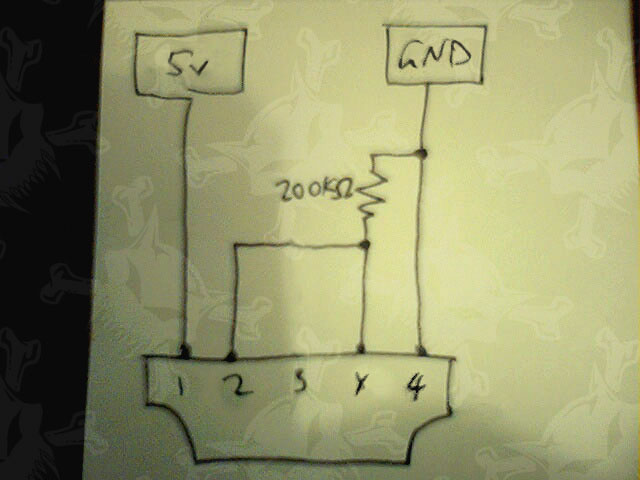
We figured there was something simple that would make the Apple device charge, and it definately had to do with the data lines (the power lines are fixed at ground and 5V). We thought "is there a enumeration chip inside every charger?" but since that's expensive and kind of overkilly we decided instead to read up on the USB protocol (go Jan!). In particular, in her fantastic book there's a part about the low level signaling states. Since you want to get the iPod charging, but NOT make it try to enumerate, we figured that we should see if there was some sort of special state you could put the data lines into that would say "no computer is attached but there is power". Turns out there is! It's called the SEI and occurs when BOTH data lines are at 3V.
Now to test. We stole an iPod from a friend and cut open a cable so we could mess with the data lines. We tried 3 options each - connected to ground, connected to 3V and not connected (float). At the same time we measured the current draw going thru the power line. We found the following:

OK, so yes when the pins are floating no charging occurs. The next thing to note is that whether the pins are pulled up or down effects the current draw. Since this was the first Mintyboost, using the MAX756, we wanted to use the lower 100mA rate so one pin pulled down and another pulled up. This would be more efficient for the battery use and keep the chip from getting hot (it could provide 250mA but didn't like it much).
Thus was born Mintyboost v1.1!

The iPhone and larger iPods
This worked ok for about a year, then people starting getting the newer iPods and noticed that the Mintyboost didn't work anymore.More testing!

iPhones
This worked for a bit until the iPhones came out. With enormous batteries, the iPhone was not happy charging at 250mA - it wanted 500mA or even 1000mA to charge! We sought out an upgrade to the MAX756 and found the LT1302 which could provide 500mA no problem.

Apple stopped being as 'lax' with the charging interface and started being very picky about having the official chargers. We still doubted that there was an enumeration chip inside each charger - too expensive and complex. So there must be something else going on in those data lines.
Time to sacrifice an official Apple iPhone 3Gs charger!


This time both voltages on the data lines are = 49.9K / (49.9K+ 75K) * 5.0V = 2.0V
We did some experimenting (see the video up top) and determined that in fact the different voltages/resistances did effect the charging rates! Using the 2.8V&2.0V setup resulted in a 1 Amp charge rate and the 2.0V&2.0V setup resulted in a 500mA charge rate.
This made us very happy, because 500mA is within the capability of the MintyBoost chip. We redesigned the PCB to allow us to have 4 resistors on the datalines and put two 75K and two 49.9K resistors in each kit. So far we have had no problems charging any of the latest Apple devices. Hooray!
Page last edited March 11, 2013
Text editor powered by tinymce.
Change Log
What's changed?
A long history of boosting
The mintyboost is one of our oldest projects, and has evolved to work with more and more products. Here are the differences between the many versions!V1.0 - June 2006 (first release)
(Schematic is essentially the same as the v1.1 but without R4 and R5)Documented in the process page, this kit used the MAX756 boost chip from Maxim, and could provide about 100-150mA output at 5V. There were no data line resistors for pulling up or down but it worked with most things.
v1.1 - July 2006

v1.2 - April 2007
(Schematic is essentially the same as the v1.1 but with an additional resistor slot from D- to ground)Turns out that some devices wanted two pullups on either data pin, so version 1.2 had an option to use D+'s R5 resistor as either a pulldown or pullup. This version still used the MAX756.
v2.0 - August 2008

This version worked pretty well for a very long time until about the iPhone 3Gs came out at which point Apple became a lot pickier about 'authorized' chargers.
v3.0 - August 2010

A 3.3K pulldown R5 was also added to turn off low-power 'boost mode' in the LT1302 chip, this improved high-drain handling at the risk of lower efficiency at low current draw. However, at this point, almost all devices have large batteries (> 500mAh) and require high charge rates.
Page last edited March 11, 2013
Text editor powered by tinymce.
Download
Datasheets
CAD Files
v2.0 files
- v2.0 Schematic in PNG
- v2.0 Schematic and Board layout files in EagleCAD format
All of these files are available under the Creative Commons 2.5 attribution license.
v1.0, v1.1 and v1.2 files
You can use these files with the DN2474 inductor, it's single-sided so it's easy to etch at home. You can generate Gerbers or extract a postscript image (for toner transfer) easily, using EagleCAD, freely available for Mac/Win/Linux.
Here are the final files, for the kit. They use a radial inductor and have pads for a low battery indicator SMT LED. It's doublesided but there's only one trace to jumper if you're not using the low battery indicator.
I then did a minor upgrade to add a pullup and pulldown for better performance:
All of these files are available under the Creative Commons 2.5 attribution license.
Page last edited March 11, 2013
Text editor powered by tinymce.