
Code
This page contains a CircuitPython demo project that plays 4-track stems loaded from 4 wave files stored in the devices 4 GB eMMC storage.
Getting the Program's Files
To use the application, you need to obtain code.py with the program, and the other project files to place on the SP-1 CIRCUITPY drive.
Thankfully, this can be done in one go. In the example below, click the Download Project Bundle button below to download the necessary libraries, the code.py file, and other project files in a zip file.
Connect your board to your computer via a known good data+power USB cable. The board should show up in your File Explorer/Finder (depending on your operating system) as a flash drive named CIRCUITPY.
Extract the contents of the zip file, copy the lib directory files to CIRCUITPY/lib. Copy the code.py file, other required files to your CIRCUITPY drive. The program should self start.
# SPDX-FileCopyrightText: Copyright (c) 2026 Tim Cocks for Adafruit Industries
#
# SPDX-License-Identifier: MIT
"""Four stems off the eMMC *as four WAV files*, four faders controling their level."""
# pylint: skip-file
import gc
import time
import audiobusio
import board
import digitalio
import adafruit_cs42l42
# `adafruit_tas2505` is imported inside `DriverAudio.__init__`, and only
# when a speaker is actually wanted.
import sp1_controls
import sp1_wavplayer
__version__ = "3.2.0"
STEMS = (0, 1, 2, 3) # stem per fader, left to right
TAPER = 2 # fader**TAPER -> voice level; see the docstring
FADER_POLL = 4 # faders sampled per chunk; see poll_count()
BAR = 12 # characters in a meter bar
GC_EVERY = 64
# --------------------------------------------------------------------------
# the playlist, and the four buttons on LADDER2
PLAYLIST = sp1_wavplayer.DEFAULT_MOUNT + "/playlist.json"
MAX_PLAYLIST_BYTES = 8192
REPEAT = False
# VOL+/VOL- move the live output's level by this much
VOLUME_STEP = 0.05
HOLD_DELAY = 0.45
REPEAT_INTERVAL = 0.12
BUTTON_LOCKOUT = 0.08
# ROCKER- past this far into a track restarts it rather than going back one.
PREV_RESTART_SECONDS = 3.0
RATE = sp1_wavplayer.RATE
BLOCK_SECONDS = sp1_wavplayer.BLOCK_SECONDS
I2S_BUFFER_MS = 16 # I2SOut.c's `buffer_length_ms`
I2S_DMA_BYTES = (RATE * I2S_BUFFER_MS * 2 * 2 // 1000 + 3) & ~3 # 3,072 B
I2S_DMA_BUFFERS = 2
SCLK_HZ = 3_072_000
SCLK_PER_FRAME = 64
BIT_DEPTH = 24
CS_MIN_DB = -62.0
TAS_MIN_DB = -63.5
SPEAKER_VOLUME = 0.85 # of 0 to -63.5 dB digital: -9.5 dB
SPEAKER_GAIN = 12 # class-D driver, dB: one of 6/12/18/24/32
DETECT_DEBOUNCE_MS = 500
RAMP_STEPS = 6
RAMP_PAUSE = 0.004
OUTPUTS = ("none", "headphones", "speaker", "both", "auto")
def _fraction_to_db(value, min_db):
"""0.0-1.0 -> dB, linear in dB (so it is linear in perceived loudness)."""
if value <= 0.0:
return min_db
if value >= 1.0:
return 0.0
return min_db * (1.0 - value)
class DriverAudio:
"""The oscillator, both codecs and the I2S bus using the driver libraries."""
def __init__(
self,
output="headphones",
volume=0.5,
minus6=False,
speaker_volume=SPEAKER_VOLUME,
speaker_gain=SPEAKER_GAIN,
speaker_ramp=False,
speaker=True,
i2c=None,
):
if output not in OUTPUTS:
raise ValueError("output must be one of {}".format(OUTPUTS))
self.speaker_ramp = speaker_ramp
self._output = output
self._muted = True
self._sample = None
self._loop = False
self._reserve = None
self._osc = None
self._cs_reset = None
self._tas_reset = None
self.headphone = None # adafruit_cs42l42.CS42L42
self.speaker_dac = None # adafruit_tas2505.TAS2505, or None
self.i2s = None
try:
self._osc = digitalio.DigitalInOut(board.OSC_EN)
self._osc.direction = digitalio.Direction.OUTPUT
self._osc.value = True # SCLK, and everything downstream
self._cs_reset = digitalio.DigitalInOut(board.CS42_RESET)
self._cs_reset.direction = digitalio.Direction.OUTPUT
self._cs_reset.value = False
if i2c is None:
i2c = board.I2C()
self.headphone = adafruit_cs42l42.CS42L42(i2c, reset_pin=self._cs_reset)
self.headphone.configure_clocks(sclk_hz=SCLK_HZ)
self.headphone.configure_asp(
sample_rate=RATE,
bit_depth=BIT_DEPTH,
generate_lrck=True,
sclk_per_frame=SCLK_PER_FRAME,
)
self.headphone.headphone_output = True
self.headphone.muted = True
self.headphone.full_scale_volume = -6.0 if minus6 else 0.0
self.headphone.dac_volume = _fraction_to_db(volume, CS_MIN_DB)
self.headphone.enable_tip_sense(DETECT_DEBOUNCE_MS)
if speaker:
self._tas_reset = digitalio.DigitalInOut(board.TAS_RESET)
self._tas_reset.direction = digitalio.Direction.OUTPUT
self._tas_reset.value = False
time.sleep(0.01)
self._tas_reset.value = True
time.sleep(0.01)
import adafruit_tas2505 # 22.6 KB of heap: see the top
self.speaker_dac = adafruit_tas2505.TAS2505(i2c)
self.speaker_dac.configure_clocks(
RATE, BIT_DEPTH, bclk_ratio=SCLK_PER_FRAME
)
self.speaker_dac.speaker_output = True
self.speaker_dac.dac_mute = True
self.speaker_dac.speaker_power = False
self.speaker_dac.speaker_volume = 0.0 # analog: no pad
self.speaker_dac.speaker_gain = speaker_gain
self.speaker_dac.dac_volume = _fraction_to_db(
speaker_volume, TAS_MIN_DB
)
self.i2s = audiobusio.I2SOut(
board.I2S_BCLK, board.I2S_LRCLK, board.I2S_DOUT, external_clock=True
)
except Exception:
self.deinit()
raise
# -- playing -----------------------------------------------------------
def reserve(self):
"""Hold the DMA buffers' worth of heap until the next `play()`.
Returns the bytes held. Idempotent, and free to call on a path that
never plays -- `stop()` and `deinit()` drop it too.
"""
if self._reserve is None:
self._reserve = [bytearray(I2S_DMA_BYTES) for _ in range(I2S_DMA_BUFFERS)]
return I2S_DMA_BUFFERS * I2S_DMA_BYTES
def _drop_reserve(self):
if self._reserve is not None:
self._reserve = None
gc.collect()
def play(self, sample, loop=False, strict=True):
"""Play a 48 kHz sample, muting across the swap.
`sample` is anything `audiobusio.I2SOut.play()` takes -- here a
`RawSample` of silence and then the player's `audiomixer.Mixer`.
Leaves the output muted or unmuted exactly as it found it.
"""
rate = getattr(sample, "sample_rate", RATE)
if strict and rate != RATE:
raise ValueError(
"this board is {} Hz only ({} Hz would play {:+.2f} % off "
"pitch) -- resample on the host, or pass "
"strict=False".format(RATE, rate, 100.0 * (RATE - rate) / rate)
)
live = not self._muted
if live:
self._mute_all() # before the bus stops. Always.
self.i2s.stop()
self._sample = sample
self._loop = loop
self._drop_reserve()
self.i2s.play(sample, loop=loop)
if live:
self._apply_output()
def stop(self):
"""Mute over I2C, then stop the bus. Idempotent."""
self._mute_all()
self._muted = True
if self.i2s is not None:
self.i2s.stop()
self._sample = None
self._drop_reserve()
def pause(self):
self._mute_all()
self._muted = True
if self.i2s is not None and self.i2s.playing:
self.i2s.pause()
def resume(self):
if self.i2s is not None and self.i2s.paused:
self.i2s.resume()
@property
def playing(self):
return self.i2s is not None and self.i2s.playing
# -- level and routing -------------------------------------------------
@property
def muted(self):
"""The master mute. False routes according to `output`."""
return self._muted
@muted.setter
def muted(self, value):
value = bool(value)
self._muted = value
if value:
self._mute_all()
else:
self._apply_output()
@property
def output(self):
"""Which outputs are live"""
return self._output
@output.setter
def output(self, value):
if value not in OUTPUTS:
raise ValueError("output must be one of {}".format(OUTPUTS))
self._output = value
if self._muted:
self._mute_all()
else:
self._apply_output()
def update(self):
"""Re-check the jack in `output="auto"`. Returns True if it changed."""
if self._output != "auto" or self._muted:
return False
if self._auto_targets() == self._live:
return False
self._apply_output()
return True
@property
def headphones_connected(self):
"""The CS42L42's debounced tip sense. Nothing routes on it for you."""
return self.headphone.headphone_detected
@property
def volume(self):
"""Headphone level, 0.0-1.0 (linear in dB). The speaker has its own."""
return 1.0 - self.headphone.dac_volume / CS_MIN_DB
@volume.setter
def volume(self, value):
self.headphone.dac_volume = _fraction_to_db(value, CS_MIN_DB)
@property
def minus6(self):
"""The headphone amp's -6 dB analog pad"""
return self.headphone.full_scale_volume == -6.0
@minus6.setter
def minus6(self, value):
self.headphone.full_scale_volume = -6.0 if value else 0.0
@property
def speaker_volume(self):
if self.speaker_dac is None:
return None
return 1.0 - self.speaker_dac.dac_volume / TAS_MIN_DB
@speaker_volume.setter
def speaker_volume(self, value):
if self.speaker_dac is not None:
self.speaker_dac.dac_volume = _fraction_to_db(value, TAS_MIN_DB)
@property
def speaker_gain(self):
return None if self.speaker_dac is None else self.speaker_dac.speaker_gain
@speaker_gain.setter
def speaker_gain(self, value):
if self.speaker_dac is not None:
self.speaker_dac.speaker_gain = value
# -- the routing itself ------------------------------------------------
@property
def _live(self):
hp = not self.headphone.muted
spk = (
self.speaker_dac is not None
and self.speaker_dac.speaker_power
and not self.speaker_dac.dac_mute
)
return hp, spk
def _auto_targets(self):
"""(headphones, speaker) for the current `output`."""
out = self._output
if out == "auto":
out = "headphones" if self.headphones_connected else "speaker"
if out == "none":
return False, False
if out == "both":
return True, True
return out == "headphones", out == "speaker"
def _apply_output(self):
hp, spk = self._auto_targets()
if self.speaker_dac is None:
spk = False
if spk:
self._speaker_up()
self.headphone.muted = not hp
if not spk:
self._speaker_down()
def _mute_all(self):
if self.headphone is not None:
self.headphone.muted = True
self._speaker_down()
def _speaker_up(self):
spk = self.speaker_dac
if spk is None:
return
spk.speaker_power = True # class-D driver, then unmute (7.1.e:
spk.dac_mute = False # both edges measured silent this way)
def _speaker_down(self):
"""Mute, optionally ramp, then power the driver down."""
spk = self.speaker_dac
if spk is None:
return
was_up = spk.speaker_power
spk.dac_mute = True
if was_up and self.speaker_ramp:
db = spk.dac_volume
for i in range(RAMP_STEPS):
spk.dac_volume = db + (TAS_MIN_DB - db) * (i + 1) / float(RAMP_STEPS)
time.sleep(RAMP_PAUSE)
spk.speaker_power = False
spk.dac_volume = db
else:
spk.speaker_power = False
# -- shutdown ----------------------------------------------------------
def deinit(self):
"""Mute, stop, release the bus, then power the codecs and the
oscillator down. Safe to call twice, and safe on a half-built object."""
try:
self._mute_all()
except Exception:
pass # a codec that has stopped answering must not be
# able to stop us dropping the oscillator
self._muted = True
if self.i2s is not None:
self.i2s.stop()
self.i2s.deinit()
self.i2s = None
self._sample = None
self._drop_reserve()
if self.speaker_dac is not None:
try:
self.speaker_dac.speaker_output = False # what actually
except Exception: # quiets the chip
pass
self.speaker_dac = None
if self.headphone is not None:
try:
self.headphone.power_down()
except Exception:
pass
self.headphone = None
for pin in ("_cs_reset", "_tas_reset"):
p = getattr(self, pin)
if p is not None:
p.deinit()
setattr(self, pin, None)
if self._osc is not None:
self._osc.value = False # it draws current through SYSTEM_OFF
self._osc.deinit()
self._osc = None
def __enter__(self):
return self
def __exit__(self, *exc):
self.deinit()
# --------------------------------------------------------------------------
# the demo
def poll_count(poll, nstems):
"""How many faders to sample per chunk: an int 1..nstems, or "all"/"one".
Each one costs ~130 us of the chunk's slack and each *unsampled* one adds a
chunk to its own update period. On the WAV player four stems leave 11-13 ms
of a 40 ms chunk spare, the default is all of them."""
if poll == "all":
return nstems
if poll == "one":
return 1
poll = int(poll)
if not 1 <= poll <= nstems:
raise ValueError("poll must be 1-%d, 'one' or 'all'" % nstems)
return poll
def _bar(v):
n = int(v * BAR + 0.5)
return "#" * n + "-" * (BAR - n)
class FaderMix:
"""The four faders, wired to a `Player`'s four voices."""
def __init__(self, player, controls, taper=TAPER, poll=FADER_POLL, measure=False):
self.player = player
self.controls = controls
self.taper = taper
self.per_chunk = poll_count(poll, player.nstems)
self.next = 0
self.measure = measure
self.hook_us_max = 0.0
self.hook_us_total = 0.0
self.hook_calls = 0
self.changes = 0
self._adc = controls._faders
if len(self._adc) < player.nstems:
raise ValueError("need %d faders" % player.nstems)
self._raw = [f.value for f in self._adc]
self._deadband = sp1_controls.FADER_DEADBAND
self._scale = sp1_controls.fader_scale
self._voice = player.mixer.voice
self._n = player.nstems
self.levels = [0.0] * self._n
for i in range(self._n):
self._set(i, self._raw[i])
def _set(self, i, raw):
"""One fader's raw reading -> both banks' level for that stem."""
g = self._scale(raw)
if self.taper != 1:
g = g**self.taper
self.levels[i] = g
self._voice[i].level = g
self._voice[self._n + i].level = g
def poll(self, player=None, stats=None):
"""The `on_chunk` hook. Signature takes the player's two arguments so
it can be passed straight in, and ignores both."""
t0 = time.monotonic_ns() if self.measure else 0
adc = self._adc
raw = self._raw
db = self._deadband
n = self._n
i = self.next
for _ in range(self.per_chunk):
r = adc[i].value
if r - raw[i] >= db or raw[i] - r >= db:
raw[i] = r
self._set(i, r)
self.changes += 1
i = i + 1 if i + 1 < n else 0
self.next = i
if not self.measure:
return 0.0
us = (time.monotonic_ns() - t0) / 1000.0
self.hook_us_total += us
self.hook_calls += 1
if us > self.hook_us_max:
self.hook_us_max = us
return us
@property
def hook_us_mean(self):
return self.hook_us_total / self.hook_calls if self.hook_calls else 0.0
def meter(self):
return " ".join(
"F%d %s %.2f" % (i + 1, _bar(v), v) for i, v in enumerate(self.levels)
)
# --------------------------------------------------------------------------
# the playlist
class Track:
"""One entry of the playlist"""
def __init__(self, path, title=None, names=None):
self.path = path
self.title = title if title else path.rsplit("/", 1)[-1]
self.names = names
def __repr__(self):
return "<Track %s>" % self.path
def _entry(item, root):
"""One decoded JSON entry -> a `Track`. Raises ValueError, with the entry
in the message: a playlist that will not load should say which line."""
names = title = None
if isinstance(item, str):
path = item
elif isinstance(item, dict):
path = item.get("path") or item.get("song") or item.get("dir")
title = item.get("title") or item.get("name")
names = item.get("stems") or item.get("files")
if names is not None:
names = [str(n) for n in names]
if not path:
raise ValueError("no `path` in playlist entry %r" % (item,))
else:
raise ValueError(
"a playlist entry is a path or an object with one, " "not %r" % (item,)
)
path = str(path)
if not path.startswith("/"):
path = root + "/" + path
while path.endswith("/"):
path = path[:-1]
return Track(path, title, names)
def load_playlist(source=None, root=None):
"""Read the playlist. Returns `(tracks, repeat, name)`, or `(None,...)`.
`source` is a path to a JSON file, an already-decoded list of entries, or
`None` for `PLAYLIST` on the mounted card.
`repeat` is the file's own `"repeat"` key or `None` if it did not say.
"""
if root is None:
root = sp1_wavplayer.DEFAULT_MOUNT
if isinstance(source, (list, tuple)):
return [_entry(x, root) for x in source], None, "argument"
name = PLAYLIST if source is None else source
try:
fh = open(name, "r")
except OSError:
if source is None:
return None, None, None # no playlist here; play one song
raise
try:
text = fh.read(MAX_PLAYLIST_BYTES + 1)
finally:
fh.close()
if len(text) > MAX_PLAYLIST_BYTES:
raise ValueError("%s is larger than %d B" % (name, MAX_PLAYLIST_BYTES))
import json
try:
data = json.loads(text)
except (ValueError, SyntaxError) as err:
raise ValueError("%s is not valid JSON: %s" % (name, err))
text = None
repeat = None
if isinstance(data, dict):
repeat = data.get("repeat")
items = data.get("songs") or data.get("tracks") or data.get("playlist")
if items is None:
raise ValueError("%s has no `songs` list" % name)
else:
items = data
if not isinstance(items, (list, tuple)):
raise ValueError(
"%s: the song list is a %s, not a list" % (name, type(items).__name__)
)
if not items:
raise ValueError("%s lists no songs" % name)
tracks = [_entry(x, root) for x in items]
if repeat is not None:
repeat = bool(repeat)
return tracks, repeat, name
def open_track(tracks, index, need_stems):
"""`open_song()` on `tracks[index]`, stepping over the ones that will not.
Returns `(song, index)`
`need_stems` is the highest stem number the player is wired for, so a song
with too few of them is refused here rather than as an IndexError inside
the refill.
"""
n = len(tracks)
for _ in range(n):
t = tracks[index]
try:
song = sp1_wavplayer.open_song(t.path, names=t.names)
if song.nstems <= need_stems:
raise sp1_wavplayer.WavError(
"%d stem(s), and this run plays stem %d" % (song.nstems, need_stems)
)
return song, index
except (OSError, ValueError, sp1_wavplayer.WavError) as err:
print("SKIPTRK|%s|%s" % (t.path, err))
print(" skipping %s -- %s" % (t.path, err))
index = index + 1 if index + 1 < n else 0
raise sp1_wavplayer.WavError("no playable song in the playlist")
def load_track(player, song):
"""Point a built `Player` at another `Song`. The player is not rebuilt."""
if max(player.stems) >= song.nstems:
raise sp1_wavplayer.WavError(
"%s has %d stem(s), and this run plays stem %d"
% (song.path, song.nstems, max(player.stems))
)
player.song = song
player._open()
# --------------------------------------------------------------------------
# the buttons
class Transport:
"""LADDER2's four buttons: VOL+/VOL- on the level, the rocker on the set.
* **VOL+/VOL-** step the level of whichever output is live, immediately
on the press and then every `REPEAT_INTERVAL` once it has been held
for `HOLD_DELAY` -- so a tap is one step and a hold is a ramp.
* **ROCKER+/ROCKER-** ask `run()` for the next or previous track. They
never repeat: holding the rocker skips one track, not forty.
`poll()` returns the skip request and nothing else. It cannot change the
track itself
"""
def __init__(
self,
audio,
controls,
step=VOLUME_STEP,
hold_delay=HOLD_DELAY,
interval=REPEAT_INTERVAL,
lockout=BUTTON_LOCKOUT,
echo=True,
):
if not controls._ladders:
raise ValueError("Transport needs Controls(buttons=True)")
self.audio = audio
self.step = step
self.hold_delay = hold_delay
self.interval = interval
self.lockout = lockout
self.echo = echo
self.skip = 0 # +1 next, -1 previous; read by run()
self.changes = 0 # volume steps written
self.skips = 0 # rocker presses honoured
self._adc = controls._ladders[1][0]
self._names = sp1_controls.LADDER2_NAMES
self._decode = sp1_controls.decode
self._held = None
self._changed = -lockout
self._repeat_at = 0.0
self.headphone_level = audio.volume
spk = audio.speaker_volume
self.speaker_level = 0.0 if spk is None else spk
# -- the hook ----------------------------------------------------------
def poll(self):
"""Sample LADDER2 once. Returns +1 (next), -1 (previous) or 0."""
name = self._decode(self._adc.value, self._names)
if name is None and self._held is None:
return 0 # the idle path: no clock, no garbage
now = time.monotonic()
if name != self._held:
if now - self._changed < self.lockout:
return 0
self._changed = now
self._held = name
if name is None:
return 0 # a release arms the next press
self._repeat_at = now + self.hold_delay
return self._act(name, False)
if name is not None and now >= self._repeat_at:
self._repeat_at = now + self.interval
return self._act(name, True)
return 0
def _act(self, name, repeat):
if name == "VOL+":
self._level(self.step, repeat)
elif name == "VOL-":
self._level(-self.step, repeat)
elif repeat:
return 0 # the rocker does not auto-repeat
elif name == "ROCKER+":
self.skip = 1
self.skips += 1
return 1
elif name == "ROCKER-":
self.skip = -1
self.skips += 1
return -1
return 0
def take(self):
"""The pending skip request, cleared. `run()`'s side of `poll()`."""
s = self.skip
self.skip = 0
return s
# -- the level ---------------------------------------------------------
def targets(self):
"""`(headphones, speaker)`, which levels VOL+/VOL- are moving."""
hp, spk = self.audio._auto_targets()
if self.audio.speaker_dac is None:
spk = False
if not (hp or spk):
hp = True
return hp, spk
def _level(self, delta, repeat):
hp, spk = self.targets()
if hp:
self.headphone_level = _clamp01(self.headphone_level + delta)
self.audio.volume = self.headphone_level
if spk:
self.speaker_level = _clamp01(self.speaker_level + delta)
self.audio.speaker_volume = self.speaker_level
self.changes += 1
if self.echo and not repeat:
print(
"VOL|%s|%.3f|%.1f"
% (
"hp" if hp else "spk",
self.headphone_level if hp else self.speaker_level,
(
_fraction_to_db(self.headphone_level, CS_MIN_DB)
if hp
else _fraction_to_db(self.speaker_level, TAS_MIN_DB)
),
)
)
def meter(self):
hp, spk = self.targets()
out = []
if hp:
out.append(
"HP %s %.2f (%.0f dB)"
% (
_bar(self.headphone_level),
self.headphone_level,
_fraction_to_db(self.headphone_level, CS_MIN_DB),
)
)
if spk:
out.append(
"SPK %s %.2f (%.0f dB)"
% (
_bar(self.speaker_level),
self.speaker_level,
_fraction_to_db(self.speaker_level, TAS_MIN_DB),
)
)
return " ".join(out)
# --------------------------------------------------------------------------
# the run
def _clamp01(v):
return 0.0 if v < 0.0 else (1.0 if v > 1.0 else v)
def _announce(song):
"""The SONG|/STEM| lines, once per track"""
print(
"SONG|%s|%d|%d|%.2f|%d|%d"
% (
song.path,
song.nstems,
song.blocks,
song.seconds,
1 if song.aligned else 0,
1 if song.ragged else 0,
)
)
for i in range(song.nstems):
print("STEM|%d|%s|%d|%d" % (i, song.paths[i], song.starts[i], song.sizes[i]))
if not song.aligned:
print(
" (a stem's `data` does not start on a 512 B boundary -- "
"every read leaves f_read's fast path, at about half the "
"rate; re-prepare it with tools/sp1_wav_prep.py)"
)
def _aggregate(agg, st):
"""One track's `stats` into the run's. The shape stays `Player.play()`'s."""
for k in (
"chunks",
"blocks",
"underruns",
"slips",
"seconds",
"audio_seconds",
"fill_ms_sum",
):
agg[k] += st[k]
for k in ("fill_ratio", "fill_ms_max"):
if st[k] > agg[k]:
agg[k] = st[k]
# A chunk boundary is a handover *between* two chunks, so a track of `n`
# chunks has `n - 1` of them -- and the dead air is per boundary.
agg["boundaries"] += st["chunks"] - 1 if st["chunks"] else 0
agg["tracks"] += 1
def run(
seconds=None,
at=0.0,
path=None,
playlist=None,
repeat=None,
track=0,
stems=STEMS,
output="headphones",
volume=0.35,
taper=TAPER,
poll=FADER_POLL,
buttons=True,
volume_step=VOLUME_STEP,
high_speed=True,
chunk_bytes=None,
fade_ms=None,
gc_every=GC_EVERY,
mixer_pad=None,
mixer_buffer=None,
mount=True,
progress=5.0,
measure=False,
watch=None,
speaker=None,
):
"""Play a playlist off the card with the faders on its stems.
Everything is built here and released on the way out, including on Ctrl-C.
**What gets played.** `run()` with neither argument reads `PLAYLIST`
(`/sd/playlist.json`) and plays it in order; if there is no such file it
plays `sp1_wavplayer.DEFAULT_SONG`,
d.run() # the card's playlist
d.run(path="/sd/songs/test_song") # one song, playlist ignored
d.run(playlist="/sd/set2.json") # a different playlist
d.run(playlist=["songs/a", "songs/b"]) # a playlist from the REPL
d.run(playlist=False) # never look for one
`repeat` starts the list again at the end; `None` takes the file's own
`"repeat"` key, and `REPEAT` if it did not say one. It is off by default.
`track` is where in the list to start, `at` is seconds into that first
song, and `seconds` is a budget for the whole run.
`buttons` enable VOL+/VOL- on the level and the rocker on the set, polled
once a chunk out of the same hook as the faders.
`watch(player, stats, mix)` is called once a chunk, right after the faders
are polled
`speaker` is the memory knob: `None` builds the TAS2505 only when `output`
can reach it, `True` always, `False` never.
`mixer_pad` is the silence at every chunk boundary, in frames.
Returns one `stats` dict for the whole run, in `Player.play()`'s own shape
-- counts summed, worst cases maximised -- plus `tracks` and `played`.
"""
audio = controls = player = transport = None
gc.collect()
dev = sp1_wavplayer.mount_card(high_speed=high_speed) if mount else None
try:
if dev is not None:
print("BUS|%d|%d" % (dev.frequency, 1 if dev.high_speed else 0))
file_repeat = source = None
tracks = None
if playlist is False:
pass
elif playlist is not None:
tracks, file_repeat, source = load_playlist(playlist)
elif path is None:
tracks, file_repeat, source = load_playlist(None)
if tracks is None:
tracks = [Track(path if path is not None else sp1_wavplayer.DEFAULT_SONG)]
source = "path"
if repeat is None:
repeat = REPEAT if file_repeat is None else file_repeat
gc.collect()
print("LIST|%d|%s|%d" % (len(tracks), source, 1 if repeat else 0))
for i in range(len(tracks)):
print("TRACK|%d|%s|%s" % (i, tracks[i].path, tracks[i].title))
if len(tracks) > 1:
print(
" playlist: %d song(s) from %s%s"
% (len(tracks), source, ", repeating" if repeat else "")
)
index = track % len(tracks)
need = max(stems) if stems else 0
song, index = open_track(tracks, index, need)
_announce(song)
if at and int(at / BLOCK_SECONDS) >= song.blocks:
raise ValueError(
"%.1f s is past the end of a %.1f s song" % (at, song.seconds)
)
if speaker is None:
speaker = output in ("speaker", "both", "auto")
audio = DriverAudio(output=output, volume=volume, speaker=speaker)
audio.reserve()
controls = sp1_controls.Controls(
buttons=buttons, faders=True, battery=False, charger=False
)
player = sp1_wavplayer.Player(
song,
audio,
stems=stems,
chunk_bytes=chunk_bytes,
fade_ms=fade_ms,
gc_every=gc_every,
mixer_pad=mixer_pad,
mixer_buffer=mixer_buffer,
)
mix = FaderMix(player, controls, taper=taper, poll=poll, measure=measure)
if buttons:
transport = Transport(audio, controls, step=volume_step)
mix.transport = transport
need = max(player.stems)
dead = player.dead_air_ms
played = ",".join([str(x) for x in player.stems])
print(
"PLAY|%s|%d|%d|%d|%.3f|%d|%d|%.3f|%d|%.2f"
% (
played,
int(at / BLOCK_SECONDS),
song.blocks,
player.chunk_bytes,
player.chunk_seconds,
gc.mem_free(),
player.fade_frames,
player.fill_ratio_predicted,
player.mixer_buffer,
dead,
)
)
if player.chunk_shrunk:
print(
" (the heap only had room for %d B chunks -- %.0f ms, so a "
"boundary %.1f times a second)"
% (
player.chunk_bytes,
player.chunk_seconds * 1e3,
1.0 / player.chunk_seconds,
)
)
print(
" stems %s on %d voices, %d B chunks (%.0f ms)"
% (
played,
2 * player.nstems,
player.chunk_bytes,
player.chunk_seconds * 1e3,
)
)
print(
" faders: %s"
% " ".join(
"FADER%d -> stem %d" % (i + 1, st) for i, st in enumerate(player.stems)
)
)
print(
" poll %d fader(s) a chunk, %.0f Hz each, taper %s"
% (
mix.per_chunk,
mix.per_chunk / (player.nstems * player.chunk_seconds),
taper,
)
)
if transport is not None:
print(
" buttons: VOL+/VOL- step %.2f (%.1f dB), ROCKER+/- "
"next/previous, sampled every chunk"
% (volume_step, volume_step * -CS_MIN_DB)
)
print(" level: %s" % transport.meter())
else:
print(
" buttons: off (buttons=False) -- the hook is the plain "
"fader demo's"
)
print(
" mixer %d B, %d-frame block -> %.3f ms of silence a boundary "
"(%.2f%% of the song)"
% (
player.mixer_buffer,
player.mixer_buffer // 8,
dead,
100.0 * dead / (dead + player.chunk_seconds * 1e3),
)
)
# The line to quote when reporting how a run sounded: gap, ramp and
# rate are the whole of what a listener is being asked to judge.
print(
" boundary: gap %.3f ms (pad %d frame(s)) + ramp %.3f ms "
"(%d frame(s)) a side, %.1f times a second"
% (
dead,
player.mixer_pad,
player.fade_frames / (RATE / 1000.0),
player.fade_frames,
1.0 / (player.chunk_seconds + dead / 1e3),
)
)
print("MIX|%s" % ",".join("%.3f" % v for v in mix.levels))
print(" start %s" % mix.meter())
state = [time.monotonic()]
def tick(p, st):
mix.poll()
skip = transport.poll() if transport is not None else 0
if watch is not None:
watch(p, st, mix)
if progress and time.monotonic() - state[0] >= progress:
state[0] = time.monotonic()
print(
"POS|%.1f|%d|%.2f|%s|%s"
% (
st["blocks"] * BLOCK_SECONDS,
st["underruns"],
st["fill_ratio"],
",".join("%.3f" % v for v in mix.levels),
mix.meter(),
)
)
if skip:
audio.muted = True
raise KeyboardInterrupt
agg = {
"chunks": 0,
"blocks": 0,
"underruns": 0,
"slips": 0,
"seconds": 0.0,
"audio_seconds": 0.0,
"fill_ratio": 0.0,
"fill_ms_max": 0.0,
"fill_ms_sum": 0.0,
"fill_ratio_mean": 0.0,
"dead_ms": 0.0,
"boundaries": 0,
"tracks": 0,
"stems": tuple(player.stems),
"interrupted": False,
"played": [],
}
print(" playing -- move the faders. Ctrl-C to stop.")
left = seconds
skip_at = at
wall = time.monotonic()
first = True
while True:
if not first:
_announce(song)
first = False
print(
"NOW|%d|%d|%s|%s|%.1f"
% (index, len(tracks), song.path, tracks[index].title, song.seconds)
)
print(
" [%d/%d] %s -- %.1f s"
% (index + 1, len(tracks), tracks[index].title, song.seconds)
)
block = int(skip_at / BLOCK_SECONDS)
if block >= song.blocks:
block = 0
skip_at = 0.0
audio.muted = False
st = player.play(block, song.blocks - block, seconds=left, on_chunk=tick)
_aggregate(agg, st)
agg["played"].append(tracks[index].path)
print(
"TSTAT|%d|%s|%d|%d|%d|%d|%.2f"
% (
index,
tracks[index].path,
st["chunks"],
st["blocks"],
st["underruns"],
st["slips"],
st["audio_seconds"],
)
)
req = transport.take() if transport is not None else 0
if st.get("interrupted") and not req:
agg["interrupted"] = True # a real Ctrl-C, not the rocker
break
if left is not None:
left -= st["audio_seconds"]
if left <= 0.0:
break
n = len(tracks)
if req < 0:
if st["blocks"] * BLOCK_SECONDS < PREV_RESTART_SECONDS:
index = index - 1 if index else n - 1
elif req > 0:
index = index + 1 if index + 1 < n else 0
else:
if index + 1 >= n and not repeat:
break # the set played out
index = index + 1 if index + 1 < n else 0
song, index = open_track(tracks, index, need)
load_track(player, song)
if agg["boundaries"]:
agg["fill_ratio_mean"] = (
agg["fill_ms_sum"] / agg["boundaries"] / (player.chunk_seconds * 1e3)
)
gap = (agg["seconds"] - agg["audio_seconds"]) / max(1, agg["boundaries"])
agg["dead_ms"] = gap * 1e3
agg["frames"] = agg["blocks"] * sp1_wavplayer.BLOCK_FRAMES
agg["wall_seconds"] = time.monotonic() - wall
print(
"STATS|%d|%d|%d|%.3f|%.1f|%.2f|%.2f|%d|%d|%.3f"
% (
agg["chunks"],
agg["blocks"],
agg["underruns"],
agg["fill_ratio"],
agg["fill_ms_max"],
agg["audio_seconds"],
agg["seconds"],
gc.mem_free(),
agg["slips"],
agg["fill_ratio_mean"],
)
)
print(
"HOOK|%.1f|%d|%.4f|%d|%.1f|%.4f"
% (
mix.hook_us_max,
mix.changes,
mix.hook_us_max / (player.chunk_seconds * 1e6),
1 if measure else 0,
mix.hook_us_mean,
mix.hook_us_mean / (player.chunk_seconds * 1e6),
)
)
print("DEAD|%.3f|%.3f" % (gap * 1e3, dead))
if transport is not None:
print(
"BTN|%d|%d|%.3f|%.3f"
% (
transport.changes,
transport.skips,
transport.headphone_level,
transport.speaker_level,
)
)
print(
" %d track(s): %.1f s played in %.1f s -- %d chunk(s), "
"%d underrun(s), %d slip(s), worst fill %.0f%% of a chunk "
"(%.0f%% mean)"
% (
agg["tracks"],
agg["audio_seconds"],
agg["wall_seconds"],
agg["chunks"],
agg["underruns"],
agg["slips"],
agg["fill_ratio"] * 100,
agg["fill_ratio_mean"] * 100,
)
)
print(" dead air %.2f ms a boundary (%.2f ms predicted)" % (gap * 1e3, dead))
if measure:
print(
" fader hook: %.0f us a chunk (%.1f%%), worst %.0f us, "
"%d level change(s)"
% (
mix.hook_us_mean,
100.0 * mix.hook_us_mean / (player.chunk_seconds * 1e6),
mix.hook_us_max,
mix.changes,
)
)
else:
print(
" %d fader level change(s) (hook not timed -- measure=True)"
% mix.changes
)
if transport is not None:
print(
" buttons: %d volume step(s), %d skip(s) -- %s"
% (transport.changes, transport.skips, transport.meter())
)
print(" final %s" % mix.meter())
return agg
finally:
# Mute over I2C before anything stops
if audio is not None:
audio.stop()
if player is not None:
player.deinit()
if audio is not None:
audio.deinit()
if controls is not None:
controls.deinit()
if mount:
sp1_wavplayer.umount_card()
gc.collect()
if __name__ == "__main__":
try:
run()
except KeyboardInterrupt:
print("\nstopped.")
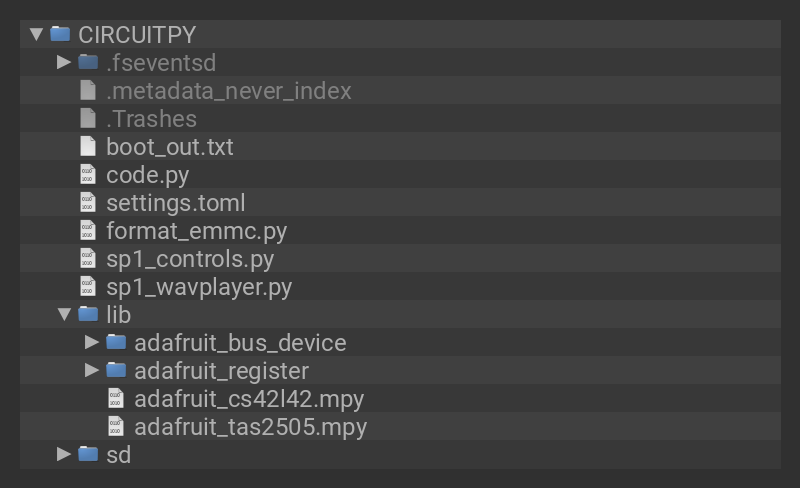
After copying the files, your drive should look like the listing below. It can contain other files as well, but must contain these at a minimum.
Page last edited September 04, 2026
Text editor powered by tinymce.


