
Code
Once you've finished setting up your Fruit Jam with CircuitPython, you can access the code and necessary libraries by downloading the Project Bundle.
To do this, click on the Download Project Bundle button in the window below. It will download to your computer as a zipped folder.
# SPDX-FileCopyrightText: 2026 Liz Clark for Adafruit Industries
#
# SPDX-License-Identifier: MIT
"""Monster eyes (eyes_viper) that look toward motion seen by a Logitech C270"""

import array
import gc
import time

import board
import displayio
import picodvi

import eye_motion
import eyes_viper
from eyes_camera import CameraSession
from motion_gaze import MotionGaze

# --- Eyes ---
CONFIG_PATH = "/config.eye"
EYE_GAP = 16  # screen pixels between the two eyes

# --- Camera and motion ---
# The camera is checked once after each eye frame
CAMERA_WAIT_MS = 5
SENSITIVITY = 0  # 0 least, 2 most sensitive (motion_gaze.py)
MIRROR_X = True
PRINT_MOTION = True  # print each detected motion target
# Seconds without motion before the eyes disappear
SLEEP_SECONDS = 15

# --- Gaze ---
GAZE_RANGE = 1.0  # less than 1.0 keeps the eyes away from the extremes
REPORT_SECONDS = 4  # 0 for no timing reports

# --- Display and eyes ---
displayio.release_displays()
framebuffer = picodvi.Framebuffer(
    320,
    240,
    clk_dp=board.CKP,
    clk_dn=board.CKN,
    red_dp=board.D0P,
    red_dn=board.D0N,
    green_dp=board.D1P,
    green_dn=board.D1N,
    blue_dp=board.D2P,
    blue_dn=board.D2N,
    color_depth=16,
)
width, height = framebuffer.width, framebuffer.height

eyes = eyes_viper.Eyes(width, height, CONFIG_PATH, gap=EYE_GAP)
load_start = time.monotonic()
eyes.begin()
print("eyes ready in %.1f s" % (time.monotonic() - load_start))

try:
    screen = memoryview(framebuffer)
except TypeError as error:
    raise RuntimeError("this firmware's framebuffer has no buffer protocol") from error
gc.collect()
eyes.attach(screen)
wait_for_vblank = getattr(framebuffer, "wait_for_vblank", None)

blank_args = array.array("i", [0, width, height, width, 0])
background_args = array.array("i", [0, width, height, width, eyes.settings.eyelid_color])

def fill_screen(args):
    if wait_for_vblank is not None:
        wait_for_vblank()
    eyes_viper.fill(screen, args)

def look_at(x, y):
    """Point the eyes; x and y run -1..1 with positive y meaning down, as in
    the camera image. eyes_viper's set_gaze() counts positive y as up, so y
    is flipped here. set_gaze() also takes the gaze from eyes_viper's own
    wandering for good, which keeps the eyes still between detections."""
    eyes.set_gaze(x, -y)

# --- Camera session, reconnecting when it fails ---
camera = gaze = current = None
previous = bytearray(38400)
stats = bytearray(208)
retry_at = 0.0

def disconnect(e):
    global camera, current, retry_at  # pylint: disable=global-statement
    if camera is not None:
        camera.close()
    camera = current = None
    retry_at = time.monotonic() + 3
    print("Camera problem, retrying in 3 s:", type(e).__name__, e)
    gc.collect()

def connect():
    global camera, current, gaze  # pylint: disable=global-statement
    try:
        camera = CameraSession(read_timeout_ms=CAMERA_WAIT_MS, stale_seconds=5)
        current = memoryview(camera.bitmap).cast("B")
        previous[:] = current
        gaze = MotionGaze(mirror_x=MIRROR_X, sensitivity=SENSITIVITY)
        print("Camera connected")
    except (RuntimeError, OSError, ValueError, MemoryError) as error:
        disconnect(error)

def print_target():
    tx = -gaze.target_x if gaze.mirror_x else gaze.target_x
    cam_x = (tx + 1000) * 15 // 2000 * 10 + 5
    cam_y = (gaze.target_y + 1000) * 11 // 2000 * 10 + 5
    print(
        f"Motion at camera x={cam_x} y={cam_y} of 160x120",
        f"(strength {gaze.strength}) -> gaze {gaze.target_x:+d}, {gaze.target_y:+d}",
    )

look_at(0, 0)
last_xy = (0, 0)
awake = not SLEEP_SECONDS
last_motion = time.monotonic()
if not awake:
    fill_screen(blank_args)
    print("Waiting for motion (screen blank)")

gc.collect()
print("free memory: %d" % gc.mem_free())
eye_frames = cam_frames = 0
draw_ns = present_ns = camera_ns = 0
report_ns = time.monotonic_ns() + REPORT_SECONDS * 1_000_000_000

while True:
    if camera is None and time.monotonic() >= retry_at:
        connect()

    # --- One monster-eye frame, only while the eyes are on screen ---
    t0 = time.monotonic_ns()
    drew = awake
    if drew:
        eyes.update()
        eyes.draw()
        t1 = time.monotonic_ns()
        eyes.present(wait_for_vblank)
        t2 = time.monotonic_ns()
    else:
        t1 = t2 = time.monotonic_ns()

    # --- The camera, motion when a frame has completed ---
    if camera is not None:
        try:
            if camera.poll():
                eye_motion.process(previous, current, stats)
                gaze.update(stats, time.monotonic())
                cam_frames += 1
                if gaze.signal == "motion":
                    last_motion = time.monotonic()
                    if not awake:
                        awake = True
                        fill_screen(background_args)
                        print("Motion detected: eyes on")
                    if PRINT_MOTION:
                        print_target()
        except (RuntimeError, OSError, ValueError, MemoryError) as error:
            disconnect(error)
    t3 = time.monotonic_ns()

    # --- Steer the eyes ---
    if gaze is not None:
        state = gaze.update(None, time.monotonic(), new_frame=False)
        xy = (state["x"], state["y"])
        if xy != last_xy:
            look_at(xy[0] / 1000 * GAZE_RANGE, xy[1] / 1000 * GAZE_RANGE)
            last_xy = xy

    # --- Blank the screen after SLEEP_SECONDS without motion ---
    if awake and SLEEP_SECONDS and time.monotonic() - last_motion >= SLEEP_SECONDS:
        awake = False
        look_at(0, 0)  # come back centered next time
        last_xy = (0, 0)
        fill_screen(blank_args)
        print(f"No motion for {SLEEP_SECONDS} s: eyes off")

    if drew:
        eye_frames += 1
        draw_ns += t1 - t0
        present_ns += t2 - t1
        camera_ns += t3 - t2

    # --- Timing report ---
    if REPORT_SECONDS and t3 >= report_ns:
        n = max(eye_frames, 1)
        line = (
            f"eyes {eye_frames / REPORT_SECONDS:.1f} fps,"
            f" camera {cam_frames / REPORT_SECONDS:.1f} fps"
            f" | ms per eye frame: draw {draw_ns / n / 1e6:.1f},"
            f" present {present_ns / n / 1e6:.1f}, camera {camera_ns / n / 1e6:.1f}"
        )
        if camera is not None:
            snap = camera.snapshot()
            line += (
                f" | dropped {snap['partial_frames_dropped']},"
                f" decode errors {snap['decode_errors']},"
                f" max decode {snap['max_decode_ns'] / 1e6:.0f} ms"
            )
        if not awake:
            line += " | eyes off"
        if gaze is not None:
            line += f" | gaze {gaze.x:+.0f}, {gaze.y:+.0f} ({gaze.signal})"
        print(line)
        eye_frames = cam_frames = 0
        draw_ns = present_ns = camera_ns = 0
        report_ns += REPORT_SECONDS * 1_000_000_000
Upload the Code, Graphics and Libraries to the Fruit Jam
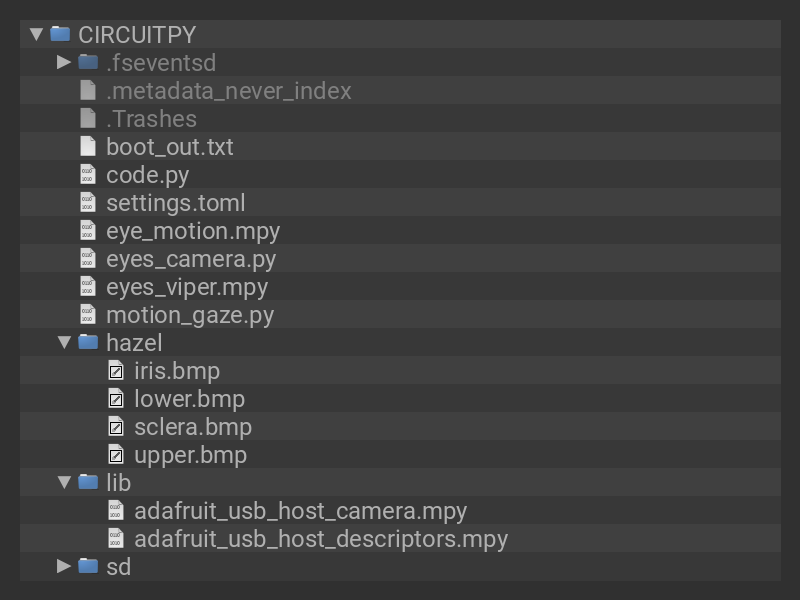
After downloading the Project Bundle, plug your Fruit Jam into your computer's USB port with a known good USB data+power cable. You should see a new flash drive appear in the computer's File Explorer or Finder (depending on your operating system) called CIRCUITPY. Unzip the folder and copy the following items to the Fruit Jam's CIRCUITPY drive.
- lib folder
- hazel folder
- config.eye
- code.py
- eye_motion.mpy
- eyes_camera.py
- eyes_viper.mpy
- motion_gaze.py
Your Fruit Jam CIRCUITPY drive should look like this after copying the files and folders:
Eyes Viper
The eyes_viper.mpy file is a CircuitPython Turbo helper file that was compiled with mpy-cross for the RP2350 on the Fruit Jam. The original source Python file is also available on GitHub:
# SPDX-FileCopyrightText: 2026 Liz Clark for Adafruit Industries
#
# SPDX-License-Identifier: MIT
"""Animated monster eyes for CircuitPython turbo, cut down for the motion
tracking project
A port of Adafruit_Monster_Eyes Arduino library It reads the same
config.eye files and eye folders off CIRCUITPY.
"""
import array
import json
import math
import random
import struct
import micropython
from micropython import const
# pylint: disable=too-many-lines, undefined-variable, too-many-locals, too-many-statements
# pylint: disable=too-many-branches
# pylint: disable=too-many-instance-attributes, too-many-arguments, invalid-name
_TICKS_MASK = const(0x1FFFFFFF) # supervisor.ticks_ms() wraps at 2**29
# The Arduino library caps the sclera texture at 4 KB, since it is mostly
# flat color; the iris is loaded at full size.
_SCLERA_MAX_BYTES = const(4096)
from supervisor import ticks_ms # pylint: disable=wrong-import-position,wrong-import-order
def _elapsed(now, then):
"""Milliseconds from then to now, across a ticks_ms() wrap."""
return (now - then) & _TICKS_MASK
# The per-eye block. Offsets and sizes in slots 0-16 and 32 are in BYTES,
# the assembly kernel's unit; the viper kernels halve them for ptr16
# indexing. The assembly reads slot n as [block, 4n], so slots 0-31 must stay
# where they are; slots 25-31 are its scratch; 32 and up only Python and
# lid_spans() read.
_B_DEST = const(0) # the eye's top-left in dest (asm: then the current row)
_B_STRIDE = const(1) # from one dest row to the next
_B_SIZE = const(2) # eye width and height in pixels, even
_B_HALF = const(3)
_B_MAP_X = const(4) # map position under the window's bottom-left
_B_MAP_Y = const(5)
_B_MAP_RADIUS = const(6)
_B_MAP_DIAMETER = const(7)
_B_POLAR = const(8) # where each table starts in data
_B_DISPLACE = const(9)
_B_BOUNDS = const(10)
_B_IRIS = const(11)
_B_IRIS_WIDTH = const(12) # texture sizes in pixels
_B_IRIS_HEIGHT = const(13)
_B_SCLERA = const(14)
_B_SCLERA_WIDTH = const(15)
_B_SCLERA_HEIGHT = const(16)
_B_IRIS_ANGLE = const(17) # rotation, 0-1023
_B_SCLERA_ANGLE = const(18)
_B_IRIS_MIRROR = const(19) # 0, or 1023 to mirror the texture
_B_SCLERA_MIRROR = const(20)
_B_PUPIL_SCALE = const(21) # iris_height * 256 / iris fraction
_B_PUPIL_COLOR = const(22) # RGB565
_B_BACK_COLOR = const(23)
_B_EYELID_COLOR = const(24)
_B_LIDS = const(32) # the lid tables in data
_B_UPPER_LID = const(33) # how open, 0-65536
_B_LOWER_LID = const(34)
_B_LID_MIRROR = const(35) # nonzero to mirror the eyelid shapes
_B_WORDS = const(36)
# Angular resolution past 512 is wasted: the renderer indexes as
# (angle * width) >> 10 with angle 0-1023, and distance is 0-127.
_TEX_MAX_W = const(512)
_TEX_MAX_H = const(128)
# ===========================================================================
# KERNELS
# ===========================================================================
@micropython.viper
def lid_spans(data: ptr16, block: ptr32):
"""Each column's visible rows for one eye, into data's bounds table as
low | high << 8, or 255 | 0 when shut. render_eye_asm() reads these."""
size = block[_B_SIZE]
lids = block[_B_LIDS] >> 1
bounds = block[_B_BOUNDS] >> 1
upper_factor = block[_B_UPPER_LID]
lower_factor = block[_B_LOWER_LID]
lid_mirror = block[_B_LID_MIRROR]
x = 0
while x < size:
column = x
if lid_mirror:
column = size - 1 - x
upper_open = int(data[lids + column])
upper_closed = int(data[lids + size + column])
lower_open = int(data[lids + size + size + column])
lower_closed = int(data[lids + size + size + size + column])
# closed + (int)(0.5 + factor * (open - closed)), as in the C:
# truncate toward zero, not floor, or the lower lid (whose span is
# negative) lands a row off.
low = lower_factor * (lower_open - lower_closed) + 32768
if low >= 0:
low = lower_closed + (low >> 16)
else:
low = lower_closed - ((0 - low) >> 16)
high = upper_factor * (upper_open - upper_closed) + 32768
if high >= 0:
high = upper_closed + (high >> 16)
else:
high = upper_closed - ((0 - high) >> 16)
if low > size - 1:
low = size - 1
elif low < 0:
low = 0
if high > size - 1:
high = size - 1
elif high < 0:
high = 0
if low >= high:
low = 255
high = 0
data[bounds + x] = low | (high << 8)
x += 1
@micropython.viper
def fill(dest: ptr16, args: ptr32):
"""Fill a rectangle: args are start, width, height, row stride, color."""
row_start = args[0]
width = args[1]
height = args[2]
stride = args[3]
color = args[4]
y = 0
while y < height:
i = row_start
end = row_start + width
while i < end:
dest[i] = color
i += 1
row_start += stride
y += 1
@micropython.viper
def bgr_row(dest: ptr16, row: ptr8, args: ptr32):
"""One row of a 24-bit BMP to RGB565, resampled: dest[args[0] + i] is
source pixel i * args[2] // args[1], for i below args[1]."""
start = args[0]
count = args[1]
source_width = args[2]
i = 0
while i < count:
s = (i * source_width // count) * 3 # stored blue, green, red
blue = int(row[s])
green = int(row[s + 1])
red = int(row[s + 2])
dest[start + i] = ((red & 0xF8) << 8) | ((green & 0xFC) << 3) | (blue >> 3)
i += 1
@micropython.viper
def eyelid_row(extent: ptr16, row: ptr8, args: ptr32):
"""Widen each column's span of lit pixels by one row of a 1-bit BMP.
args are image width, eye size, image row, palette index of "lit".
extent holds size minimum rows, then size maximum rows."""
width = args[0]
size = args[1]
image_row = args[2]
lit = args[3]
sx = 0
while sx < width:
if ((int(row[sx >> 3]) >> (7 - (sx & 7))) & 1) == lit:
column = sx * size // width
if image_row < int(extent[column]):
extent[column] = image_row
if image_row > int(extent[size + column]):
extent[size + column] = image_row
sx += 1
@micropython.viper
def address(buf: ptr8) -> int:
"""Where a buffer's data lives, as an int, for the asm kernels."""
return int(buf)
def _address(buf):
value = address(buf)
if not 0 < value < 0x40000000: # must stay a small int
raise ValueError("buffer address 0x%x can't be passed to the asm kernels" % value)
return value
@micropython.asm_thumb
def render_eye_asm(r0, r1, r2, r3):
# Called as render_eye_asm(block, data, dest), all addresses. Slot n of
# the block is at byte offset 4n, which is what the immediates below use.
ldr(r0, [r3, 0])
ldr(r1, [r3, 4])
ldr(r2, [r3, 8])
push({r0}) # the object to return
asr(r0, r0, 1)
asr(r1, r1, 1)
asr(r2, r2, 1)
mov(r7, r0)
mov(r3, r8) # r8-r11 belong to the caller
mov(r4, r9)
mov(r5, r10)
mov(r6, r11)
push({r3, r4, r5, r6})
ldr(r3, [r7, 0]) # offsets into data and dest become addresses
add(r3, r3, r2)
str(r3, [r7, 0])
ldr(r3, [r7, 32])
add(r3, r3, r1)
str(r3, [r7, 108])
ldr(r3, [r7, 36])
add(r3, r3, r1)
str(r3, [r7, 112])
ldr(r3, [r7, 40])
add(r3, r3, r1)
str(r3, [r7, 116])
ldr(r3, [r7, 44])
add(r3, r3, r1)
str(r3, [r7, 120])
ldr(r3, [r7, 56])
add(r3, r3, r1)
str(r3, [r7, 124])
ldr(r0, [r7, 8]) # sy = size - 1, the top row
sub(r0, 1)
str(r0, [r7, 100])
label(ROW)
ldr(r0, [r7, 100])
mov(r9, r0) # sy
ldr(r1, [r7, 20])
add(r1, r1, r0)
mov(r10, r1) # yy = map_y + sy
ldr(r2, [r7, 12]) # half
sub(r1, r0, r2)
asr(r3, r1, 31) # -1 below the centre
mov(r12, r3)
eor(r1, r3) # displacement row: |sy - half| folded
mul(r1, r2)
lsl(r1, r1, 1)
ldr(r3, [r7, 112])
add(r1, r1, r3)
str(r1, [r7, 104]) # this row of the displacement table
ldr(r6, [r7, 0]) # output pointer: row start
ldr(r0, [r7, 116])
sub(r0, r0, r6)
mov(r11, r0) # bounds address = r11 + output pointer
ldr(r3, [r7, 16]) # map_x + x, x = 0
lsl(r0, r2, 1)
add(r0, r0, r6)
mov(r8, r0) # end of the left half
sub(r0, r2, 1)
lsl(r0, r0, 1)
add(r4, r1, r0) # displacement for x = 0 is the far end of the row
label(LEFT)
mov(r0, r11)
add(r0, r0, r6)
ldrh(r0, [r0, 0]) # lid span: low | high << 8
mov(r2, r9)
lsl(r1, r0, 24)
lsr(r1, r1, 24)
cmp(r2, r1)
blt(L_LID)
lsr(r0, r0, 8)
cmp(r2, r0)
bgt(L_LID)
ldrh(r0, [r4, 0]) # displacement: dx | dy << 8
lsl(r1, r0, 24)
lsr(r1, r1, 24)
cmp(r1, 255)
beq(L_LID) # outside the eyeball
sub(r1, r3, r1) # LEFT: mx = map_x + x - dx
lsr(r0, r0, 8)
mov(r2, r12)
eor(r0, r2)
sub(r0, r0, r2) # dy, negated below the centre
mov(r2, r10)
add(r0, r0, r2) # my
ldr(r2, [r7, 28])
cmp(r1, r2)
bcs(L_BACK) # unsigned, so this catches mx < 0 too
cmp(r0, r2)
bcs(L_BACK)
ldr(r2, [r7, 24])
sub(r1, r1, r2)
sub(r0, r0, r2)
asr(r5, r0, 31) # -1 in the map's lower half
eor(r0, r5)
mul(r0, r2)
asr(r2, r1, 31) # -1 in the map's left half
eor(r1, r2)
add(r0, r0, r1)
eor(r2, r5) # -1 in the mirrored quadrants
lsl(r0, r0, 1)
ldr(r1, [r7, 108])
add(r0, r0, r1)
ldrh(r0, [r0, 0]) # angle | (dist + 128) << 8
lsl(r1, r0, 24)
lsr(r1, r1, 24)
lsr(r2, r2, 22) # 0 or 1023
eor(r1, r2) # 1023 - angle where mirrored
lsr(r5, r5, 31)
lsl(r5, r5, 9)
add(r1, r1, r5) # + 512 in the lower half
lsr(r0, r0, 8)
beq(L_BACK) # dist -128: back of the eye
sub(r0, 128)
bmi(L_IRIS)
ldr(r2, [r7, 72]) # sclera
add(r1, r1, r2)
lsl(r1, r1, 22)
lsr(r1, r1, 22)
ldr(r2, [r7, 80])
eor(r1, r2)
ldr(r2, [r7, 60])
mul(r1, r2)
lsr(r1, r1, 10)
ldr(r5, [r7, 64])
mul(r0, r5)
lsr(r0, r0, 7)
mul(r0, r2)
add(r0, r0, r1)
lsl(r0, r0, 1)
ldr(r1, [r7, 124])
add(r0, r0, r1)
ldrh(r0, [r0, 0])
b(L_STORE)
label(L_IRIS)
neg(r0, r0)
ldr(r2, [r7, 84])
mul(r0, r2)
lsr(r0, r0, 15)
ldr(r2, [r7, 52])
cmp(r0, r2)
bcs(L_PUPIL)
ldr(r2, [r7, 68])
add(r1, r1, r2)
lsl(r1, r1, 22)
lsr(r1, r1, 22)
ldr(r2, [r7, 76])
eor(r1, r2)
ldr(r2, [r7, 48])
mul(r1, r2)
lsr(r1, r1, 10)
mul(r0, r2)
add(r0, r0, r1)
lsl(r0, r0, 1)
ldr(r1, [r7, 120])
add(r0, r0, r1)
ldrh(r0, [r0, 0])
b(L_STORE)
label(L_PUPIL)
ldr(r0, [r7, 88])
b(L_STORE)
label(L_BACK)
ldr(r0, [r7, 92])
b(L_STORE)
label(L_LID)
ldr(r0, [r7, 96])
label(L_STORE)
strh(r0, [r6, 0])
add(r6, 2)
sub(r4, 2) # LEFT: displacement runs backwards
add(r3, 1)
mov(r0, r8)
cmp(r6, r0)
bcc_w(LEFT)
ldr(r4, [r7, 104]) # right half: displacement runs forwards from 0
ldr(r0, [r7, 12])
lsl(r0, r0, 1)
add(r0, r0, r6)
mov(r8, r0)
label(RIGHT)
mov(r0, r11)
add(r0, r0, r6)
ldrh(r0, [r0, 0])
mov(r2, r9)
lsl(r1, r0, 24)
lsr(r1, r1, 24)
cmp(r2, r1)
blt(R_LID)
lsr(r0, r0, 8)
cmp(r2, r0)
bgt(R_LID)
ldrh(r0, [r4, 0])
lsl(r1, r0, 24)
lsr(r1, r1, 24)
cmp(r1, 255)
beq(R_LID)
add(r1, r1, r3) # RIGHT: mx = map_x + x + dx
lsr(r0, r0, 8)
mov(r2, r12)
eor(r0, r2)
sub(r0, r0, r2)
mov(r2, r10)
add(r0, r0, r2)
ldr(r2, [r7, 28])
cmp(r1, r2)
bcs(R_BACK)
cmp(r0, r2)
bcs(R_BACK)
ldr(r2, [r7, 24])
sub(r1, r1, r2)
sub(r0, r0, r2)
asr(r5, r0, 31)
eor(r0, r5)
mul(r0, r2)
asr(r2, r1, 31)
eor(r1, r2)
add(r0, r0, r1)
eor(r2, r5)
lsl(r0, r0, 1)
ldr(r1, [r7, 108])
add(r0, r0, r1)
ldrh(r0, [r0, 0])
lsl(r1, r0, 24)
lsr(r1, r1, 24)
lsr(r2, r2, 22)
eor(r1, r2)
lsr(r5, r5, 31)
lsl(r5, r5, 9)
add(r1, r1, r5)
lsr(r0, r0, 8)
beq(R_BACK)
sub(r0, 128)
bmi(R_IRIS)
ldr(r2, [r7, 72])
add(r1, r1, r2)
lsl(r1, r1, 22)
lsr(r1, r1, 22)
ldr(r2, [r7, 80])
eor(r1, r2)
ldr(r2, [r7, 60])
mul(r1, r2)
lsr(r1, r1, 10)
ldr(r5, [r7, 64])
mul(r0, r5)
lsr(r0, r0, 7)
mul(r0, r2)
add(r0, r0, r1)
lsl(r0, r0, 1)
ldr(r1, [r7, 124])
add(r0, r0, r1)
ldrh(r0, [r0, 0])
b(R_STORE)
label(R_IRIS)
neg(r0, r0)
ldr(r2, [r7, 84])
mul(r0, r2)
lsr(r0, r0, 15)
ldr(r2, [r7, 52])
cmp(r0, r2)
bcs(R_PUPIL)
ldr(r2, [r7, 68])
add(r1, r1, r2)
lsl(r1, r1, 22)
lsr(r1, r1, 22)
ldr(r2, [r7, 76])
eor(r1, r2)
ldr(r2, [r7, 48])
mul(r1, r2)
lsr(r1, r1, 10)
mul(r0, r2)
add(r0, r0, r1)
lsl(r0, r0, 1)
ldr(r1, [r7, 120])
add(r0, r0, r1)
ldrh(r0, [r0, 0])
b(R_STORE)
label(R_PUPIL)
ldr(r0, [r7, 88])
b(R_STORE)
label(R_BACK)
ldr(r0, [r7, 92])
b(R_STORE)
label(R_LID)
ldr(r0, [r7, 96])
label(R_STORE)
strh(r0, [r6, 0])
add(r6, 2)
add(r4, 2) # RIGHT: displacement runs forwards
add(r3, 1)
mov(r0, r8)
cmp(r6, r0)
bcc_w(RIGHT)
ldr(r0, [r7, 0]) # next row
ldr(r1, [r7, 4])
add(r0, r0, r1)
str(r0, [r7, 0])
ldr(r0, [r7, 100])
sub(r0, 1)
str(r0, [r7, 100])
bpl_w(ROW)
pop({r3, r4, r5, r6})
mov(r8, r3)
mov(r9, r4)
mov(r10, r5)
mov(r11, r6)
pop({r0})
class _Bmp:
"""Header of an uncompressed 1- or 24-bit BMP."""
def __init__(self, path):
self.path = path
with open(path, "rb") as file:
header = file.read(54)
if len(header) < 54 or header[:2] != b"BM":
raise ValueError(path + ": not a BMP file")
(self.data_offset, info_size, self.width, height, _planes, self.bits,
compression) = struct.unpack_from("<IIiiHHI", header, 10)
if info_size < 40 or compression != 0 or self.bits not in (1, 24):
raise ValueError(path + ": needs an uncompressed 1- or 24-bit BMP")
self.top_down = height < 0 # positive height stores rows bottom up
self.height = abs(height)
self.row_bytes = ((self.width * self.bits + 31) // 32) * 4
self.lit = 1
if self.bits == 1: # the lighter palette entry is "lit"
file.seek(14 + info_size)
palette = file.read(8)
self.lit = 1 if sum(palette[4:7]) > sum(palette[0:3]) else 0
def file_row(self, image_row):
"""Byte offset of an image row, counting from the top."""
row = image_row if self.top_down else self.height - 1 - image_row
return self.data_offset + row * self.row_bytes
def _texture_size(bmp, max_bytes):
"""Size to load a texture at: the source capped to what the renderer can
address, then the longer side shrunk until it fits max_bytes. As in the
Arduino loader, too large means blurrier, not rejected."""
width = min(bmp.width, _TEX_MAX_W)
height = min(bmp.height, _TEX_MAX_H)
if max_bytes:
while width * height * 2 > max_bytes and (width > 8 or height > 4):
if width * bmp.height > height * bmp.width:
if width > 8:
width -= 1
else:
height -= 1
elif height > 4:
height -= 1
else:
width -= 1
return width, height
def _open_bmp(path, bits, label):
"""A config.eye BMP, checked for depth; None means use the solid color."""
if not path:
print("%s: none -- solid color" % label)
return None
try:
bmp = _Bmp(_resolve(path))
except (OSError, ValueError) as error:
print("%s: %s unusable (%s) -- solid color" % (label, path, error))
return None
if bmp.bits != bits:
print("%s: %s is %d-bit, needs %d -- skipped" % (label, path, bmp.bits, bits))
return None
if bits == 1 and bmp.height < 2:
return None
return bmp
def _load_texture(bmp, data, offset, width, height):
"""Decode a 24-bit BMP into data[offset:], resampled to width x height."""
row = bytearray(bmp.row_bytes)
args = array.array("i", [0, width, bmp.width])
with open(bmp.path, "rb") as file:
for y in range(height):
file.seek(bmp.file_row(y * bmp.height // height))
file.readinto(row)
args[0] = offset + y * width
bgr_row(data, row, args)
def _load_eyelid(bmp, data, open_offset, closed_offset, size, *, upper):
"""Per column of a 1-bit eyelid shape, its topmost and bottommost lit
rows, scaled to the eye and flipped to +Y up. An upper lid's top edge is
where it rests open and its bottom edge where it closes; a lower lid is
the other way round."""
extent = array.array("H", [0xFFFF]) * size + array.array("H", [0]) * size
row = bytearray(bmp.row_bytes)
args = array.array("i", [bmp.width, size, 0, bmp.lit])
with open(bmp.path, "rb") as file:
for y in range(bmp.height):
file.seek(bmp.file_row(y))
file.readinto(row)
args[2] = y
eyelid_row(extent, row, args)
span = bmp.height - 1
for column in range(size):
if extent[column] == 0xFFFF:
continue # nothing lit: keep the "no eyelid" value
top = min(max(extent[column] * (size - 1) // span, 0), size - 1)
bottom = min(max(extent[size + column] * (size - 1) // span, 0), size - 1)
if upper:
data[open_offset + column] = size - 1 - top
data[closed_offset + column] = size - 1 - bottom
else:
data[closed_offset + column] = size - 1 - top
data[open_offset + column] = size - 1 - bottom
# ===========================================================================
# CONFIG.EYE
# ===========================================================================
def _clean_json(text):
"""Strip // and /* */ comments and trailing commas, outside strings.
config.eye files carry comments, which json.loads() rejects."""
out = []
i = 0
n = len(text)
in_string = False
while i < n:
c = text[i]
if in_string:
out.append(c)
if c == "\\" and i + 1 < n:
out.append(text[i + 1])
i += 1
elif c == '"':
in_string = False
elif c == '"':
in_string = True
out.append(c)
elif c == "/" and text[i + 1 : i + 2] == "/":
while i < n and text[i] != "\n":
i += 1
continue
elif c == "/" and text[i + 1 : i + 2] == "*":
end = text.find("*/", i + 2)
i = n if end < 0 else end + 2
continue
elif c in "}]":
# Drop a comma left dangling before the close.
j = len(out) - 1
while j >= 0 and out[j] in " \t\r\n":
j -= 1
if j >= 0 and out[j] == ",":
del out[j]
out.append(c)
else:
out.append(c)
i += 1
return "".join(out)
def _channel(item):
"""One color channel, 0-255, from an int, a "0xFF" string or a 0.0-1.0
float."""
if isinstance(item, float):
item = int(item * 255.999)
elif isinstance(item, str):
item = int(item, 0)
return min(max(int(item), 0), 255)
def _dwim(value, default=0):
"""M4_Eyes' "do what I mean" number: 42, "0x2A", [255, 0, 0],
["0xFF", 0, 0] or [1.0, 0.0, 0.0]. Three-element lists become RGB565;
shorter lists use their first element."""
while isinstance(value, (list, tuple)):
if len(value) >= 3:
red = _channel(value[0])
green = _channel(value[1])
blue = _channel(value[2])
return ((red & 0xF8) << 8) | ((green & 0xFC) << 3) | (blue >> 3)
value = value[0] if value else None
if value is None:
return default
if isinstance(value, float):
return int(value + 0.5)
if isinstance(value, str):
return int(value, 0)
if isinstance(value, int): # bool included: True is 1
return int(value)
return default
def _number(value):
return isinstance(value, (int, float)) and not isinstance(value, bool)
def _angle(value):
"""config.eye angle (0-1023, or a float fraction of a turn) to the
renderer's start angle, which runs the other way."""
if isinstance(value, float):
return 1023 - (int(value * 1024) & 1023)
return 1023 - (int(value) & 1023)
class Settings:
"""Everything a config.eye can change, at the Arduino library's
defaults. Colors are RGB565."""
def __init__(self):
self.display_size = 0 # 0 fills what the screen gives one eye
self.eye_radius = 0 # 0 derives these three from display_size
self.iris_radius = 0
self.slit_pupil_radius = 0 # 0 round, -1 derived
self.coverage = 0.6
self.pupil_color = 0x0000
self.back_color = 0x5000
self.eyelid_color = 0x0000
self.iris_color = 0x001F
self.sclera_color = 0xFFFF
self.pupil_min = 0.05
self.pupil_max = 0.25
self.tracking = True
self.squint = 0.5
self.fixate = 7 # map pixels
self.iris_file = ""
self.sclera_file = ""
self.upper_file = ""
self.lower_file = ""
# Keys that may differ between the two eyes; see _Eye.
self.iris_spin = 0.0
self.sclera_spin = 0.0
self.iris_start = 512
self.sclera_start = 512
self.iris_mirror = 0
self.sclera_mirror = 0
self.eyelid_mirror = True
# For scaling: did the config set geometry, and for what eye size?
self.geometry_from_config = False
self.config_display_size = 0
def apply(self, block):
"""Apply one JSON object: the root, or a single eye's side block."""
if not isinstance(block, dict):
return
for key, attr in (
("displaySize", "display_size"),
("eyeRadius", "eye_radius"),
("irisRadius", "iris_radius"),
("slitPupilRadius", "slit_pupil_radius"),
("fixate", "fixate"),
("pupilColor", "pupil_color"),
("backColor", "back_color"),
("irisColor", "iris_color"),
("scleraColor", "sclera_color"),
):
if key in block:
setattr(self, attr, _dwim(block[key], getattr(self, attr)))
if "eyeRadius" in block or "irisRadius" in block or "slitPupilRadius" in block:
self.geometry_from_config = True
if "displaySize" in block:
self.config_display_size = self.display_size
for key, attr in (
("coverage", "coverage"),
("pupilMin", "pupil_min"),
("pupilMax", "pupil_max"),
("squint", "squint"),
):
if _number(block.get(key)):
setattr(self, attr, float(block[key]))
if "eyelidIndex" in block: # legacy grey index
self.eyelid_color = (_dwim(block["eyelidIndex"]) & 0xFF) * 0x0101
if "eyelidColor" in block:
self.eyelid_color = _dwim(block["eyelidColor"], self.eyelid_color)
if isinstance(block.get("tracking"), bool):
self.tracking = block["tracking"]
for key, attr in (
("irisTexture", "iris_file"),
("scleraTexture", "sclera_file"),
("upperEyelid", "upper_file"),
("lowerEyelid", "lower_file"),
):
if isinstance(block.get(key), str):
setattr(self, attr, block[key])
apply_per_eye(block, self)
def apply_per_eye(block, target):
"""Apply the keys that may differ between eyes to target, a Settings or
an _Eye."""
if not isinstance(block, dict):
return
for key, attr in (("irisSpin", "iris_spin"), ("scleraSpin", "sclera_spin")):
if _number(block.get(key)):
setattr(target, attr, float(block[key]))
for key, attr in (("irisAngle", "iris_start"), ("scleraAngle", "sclera_start")):
if _number(block.get(key)):
setattr(target, attr, _angle(block[key]))
for key, attr in (("irisMirror", "iris_mirror"), ("scleraMirror", "sclera_mirror")):
if key in block:
setattr(target, attr, 1023 if block[key] else 0)
if "eyelidMirror" in block:
target.eyelid_mirror = bool(block["eyelidMirror"])
class _Eye: # pylint: disable=too-few-public-methods
"""One eye: its per-eye settings, its kernel block, and its animation
state. The character's right eye mirrors the left: opposite spin, half a
turn round, unmirrored eyelids."""
def __init__(self, settings, right_eye):
self.iris_spin = -settings.iris_spin if right_eye else settings.iris_spin
self.sclera_spin = -settings.sclera_spin if right_eye else settings.sclera_spin
self.iris_start = (settings.iris_start + (512 if right_eye else 0)) & 1023
self.sclera_start = settings.sclera_start
self.iris_mirror = settings.iris_mirror
self.sclera_mirror = settings.sclera_mirror
self.eyelid_mirror = settings.eyelid_mirror != right_eye
self.block = array.array("i", [0]) * _B_WORDS
self.block_address = 0
self.origin_x = self.origin_y = 0
self.upper = self.lower = 1.0 # smoothed lid tracking
# Rotation is a phase advanced by elapsed time, in 1/1024 turns,
# rather than start + spin * uptime: a CircuitPython float has too
# few bits for the uptime product to stay smooth for long.
self.iris_phase = self.sclera_phase = 0.0
def _resolve(path):
"""config.eye paths are relative to the drive's root."""
return path if path.startswith("/") else "/" + path
# ===========================================================================
# THE EYES
# ===========================================================================
class Eyes:
"""Two animated eyes side by side on one screen, looking wherever
set_gaze() points them.
Eye 0 is the character's RIGHT eye, so it sits on the viewer's LEFT, and
reads the "right" block of config.eye; eye 1 is the left eye.
Use: begin(), attach(screen), then each frame update(), draw() and
present(); set_gaze() whenever the gaze should change.
"""
def __init__(self, screen_width, screen_height, config_path="/config.eye", gap=0):
"""
:param screen_width: screen width in pixels
:param screen_height: screen height in pixels
:param config_path: config.eye on CIRCUITPY. If it's missing or won't
parse, the built-in defaults are used.
:param gap: screen pixels to keep blank between the eyes. Each eye
stays centered in its half of the screen, so half the gap is left
at the outer edges too. A displaySize in config.eye wins.
"""
self.screen_width = screen_width
self.screen_height = screen_height
self.config_path = config_path
self.gap = gap
self.settings = Settings()
self.size = self.top = 0
self.data = None
self.eyes = []
# Set by begin(): geometry and the kernels' addresses
self.map_radius = 0
self.gaze_radius = 1.0
self._lids = 0
self._data_address = 0
self._iris_height = 1
# Set by begin() from the config: lid tracking and pupil range
self._track_factor = 1.0
self._iris_min = 0.0
self._iris_range = 0.0
# Animation state, reset by begin()
self.gaze_map_x = self.gaze_map_y = 0.0
self._iris_prev = [0.0] * 7
self._iris_next = [0.0] * 7
self._iris_frame = 0
self.iris_fraction = 0.5
self._last_update = 0
# Set by attach(): the screen and the back buffer
self._screen = self._back = None
self._back_address = 0
self._band = (0, 0)
# -- startup ------------------------------------------------------------
def begin(self):
"""Read the config, build the tables, load the textures and lids."""
settings = self.settings
doc = self._load_config(self.config_path)
self.eyes = [_Eye(settings, True), _Eye(settings, False)]
if doc:
apply_per_eye(doc.get("right"), self.eyes[0])
apply_per_eye(doc.get("left"), self.eyes[1])
max_size = min(self.screen_width // 2, self.screen_height)
# M4_Eyes configs are drawn for a 240 px eye unless they say otherwise.
reference = settings.config_display_size or 240
size = settings.display_size or max_size - self.gap
size = min(max(size, 32), 240, max_size) & ~1
settings.display_size = size
if settings.geometry_from_config and size != reference:
# Scale the config's geometry to the eye size really used, so a
# 144 px eye looks like the 240 px one it was written for.
factor = size / reference
settings.eye_radius = int(settings.eye_radius * factor + 0.5)
settings.iris_radius = int(settings.iris_radius * factor + 0.5)
if settings.slit_pupil_radius > 0:
settings.slit_pupil_radius = int(settings.slit_pupil_radius * factor + 0.5)
settings.fixate = int(settings.fixate * factor + 0.5)
print("config geometry scaled by %.3f for a %d px eye" % (factor, size))
self._finalize()
self.size = size
half = size // 2
self.map_radius = int(settings.eye_radius * math.pi * settings.coverage + 0.5)
map_radius = self.map_radius
if map_radius < 8:
raise ValueError("eye too small: map radius %d" % map_radius)
self._gaze_radius_init()
# Size every table, then allocate data once.
iris_bmp = _open_bmp(settings.iris_file, 24, "iris")
sclera_bmp = _open_bmp(settings.sclera_file, 24, "sclera")
iris_w, iris_h = _texture_size(iris_bmp, None) if iris_bmp else (1, 1)
sclera_w, sclera_h = (
_texture_size(sclera_bmp, _SCLERA_MAX_BYTES) if sclera_bmp else (1, 1)
)
polar = 0
displace = polar + map_radius * map_radius
iris = displace + half * half
sclera = iris + iris_w * iris_h
lids = sclera + sclera_w * sclera_h
bounds = lids + 4 * size
total = bounds + size
try:
self.data = array.array("H", [0]) * total
except MemoryError as error:
raise MemoryError("no room for %d bytes of eye tables" % (2 * total)) from error
data = self.data
print("eye %d px, map radius %d, tables %d bytes" % (size, map_radius, 2 * total))
t0 = ticks_ms()
iris_map_radius = self._screen2map(settings.iris_radius)
_build_polar(data, polar, map_radius, iris_map_radius, settings.slit_pupil_radius)
t1 = ticks_ms()
_build_displace(data, displace, half, settings.eye_radius, map_radius)
print("polar map %d ms, displacement %d ms" % (_elapsed(t1, t0), _elapsed(ticks_ms(), t1)))
for bmp, offset, width, height, color, label in (
(iris_bmp, iris, iris_w, iris_h, settings.iris_color, "iris"),
(sclera_bmp, sclera, sclera_w, sclera_h, settings.sclera_color, "sclera"),
):
if bmp:
_load_texture(bmp, data, offset, width, height)
print("%s: %s -> %dx%d" % (label, bmp.path, width, height))
else:
data[offset] = color
# Lids: "fully out of the way" until a file says otherwise.
for i in range(size):
data[lids + i] = data[lids + size + i] = size - 1
for path, open_offset, closed_offset, upper in (
(settings.upper_file, lids, lids + size, True),
(settings.lower_file, lids + 2 * size, lids + 3 * size, False),
):
bmp = _open_bmp(path, 1, "upper eyelid" if upper else "lower eyelid")
if bmp:
_load_eyelid(bmp, data, open_offset, closed_offset, size, upper=upper)
self._lids = lids
slice_width = self.screen_width // 2
self.top = (self.screen_height - size) // 2
for number, eye in enumerate(self.eyes):
eye.origin_x = number * slice_width + (slice_width - size) // 2
block = eye.block
for slot, value in (
(_B_SIZE, size),
(_B_HALF, half),
(_B_MAP_RADIUS, map_radius),
(_B_MAP_DIAMETER, 2 * map_radius),
(_B_POLAR, 2 * polar),
(_B_DISPLACE, 2 * displace),
(_B_BOUNDS, 2 * bounds),
(_B_IRIS, 2 * iris),
(_B_IRIS_WIDTH, iris_w),
(_B_IRIS_HEIGHT, iris_h),
(_B_SCLERA, 2 * sclera),
(_B_SCLERA_WIDTH, sclera_w),
(_B_SCLERA_HEIGHT, sclera_h),
(_B_IRIS_MIRROR, eye.iris_mirror),
(_B_SCLERA_MIRROR, eye.sclera_mirror),
(_B_PUPIL_COLOR, settings.pupil_color),
(_B_BACK_COLOR, settings.back_color),
(_B_EYELID_COLOR, settings.eyelid_color),
(_B_LIDS, 2 * lids),
(_B_LID_MIRROR, 1 if eye.eyelid_mirror else 0),
):
block[slot] = value
eye.block_address = _address(block)
self._data_address = _address(data)
self._iris_height = iris_h
self._reset_animation()
def _load_config(self, path):
"""Apply config.eye to settings; return the parsed document, or None."""
try:
with open(path, "r") as file:
text = file.read()
except OSError:
print("no %s; using built-in defaults" % path)
return None
try:
doc = json.loads(_clean_json(text))
except ValueError as error:
print("%s: parse error (%s); using built-in defaults" % (path, error))
return None
self.settings.apply(doc)
print("loaded " + path)
return doc
def _finalize(self):
"""Derive what the config left at auto, and keep the geometry
consistent enough that the iris stays on the eyeball."""
s = self.settings
size = s.display_size
s.eye_radius = s.eye_radius if s.eye_radius > 0 else size // 2 + 5
# Auto values keep the stock demon proportions at any size.
if s.iris_radius <= 0:
s.iris_radius = int(0.4583 * size + 0.5)
s.iris_radius = min(s.iris_radius, s.eye_radius - 1)
if s.slit_pupil_radius < 0:
s.slit_pupil_radius = int(0.4167 * size + 0.5)
s.slit_pupil_radius = min(s.slit_pupil_radius, s.iris_radius)
# Coverage must be large enough for the eye to look around: solving
# for the stock eye's gaze-to-map ratio gives mapRadius ~ 0.98 size.
need = 0.9818 * size / (s.eye_radius * math.pi)
if s.coverage < need * 0.98:
print("coverage %.2f too low for this eye; raising to %.2f" % (s.coverage, need))
s.coverage = need
s.coverage = min(max(s.coverage, 0.05), 1.0)
s.pupil_min = max(s.pupil_min, 0.0)
s.pupil_max = min(s.pupil_max, 1.0)
if s.pupil_min > s.pupil_max:
s.pupil_min, s.pupil_max = s.pupil_max, s.pupil_min
self._track_factor = min(max(1.0 - s.squint, 0.0), 1.0)
# A bigger iris fraction means a smaller pupil.
self._iris_min = 1.0 - s.pupil_max
self._iris_range = s.pupil_max - s.pupil_min
def _screen2map(self, value):
"""Screen radius to map radius: the same projection as the tables."""
r = self.settings.eye_radius
return math.atan2(value, math.sqrt(r * r - value * value)) / (math.pi / 2) * self.map_radius
def _map2screen(self, value):
"""Map offset to screen offset. As in the Arduino library this is a
small-angle stand-in for the inverse of _screen2map(), which is all
lid tracking needs."""
return math.sin(value / self.map_radius) * (math.pi / 2) * self.settings.eye_radius
def _gaze_radius_init(self):
"""How far the gaze may move across the map: set_gaze()'s 1.0."""
size = self.size
r = (2 * self.map_radius - size * math.pi / 2) * 0.75
# Also bound it by how far the iris moves in screen pixels; 0.2433 is
# calibrated so the stock 240 px demon eye keeps its original radius.
travel = 0.2433 * size
s = min(travel / (math.pi / 2 * self.settings.eye_radius), 0.999)
r_screen = self.map_radius * math.asin(s)
if r > r_screen * 1.10:
r = r_screen
self.gaze_radius = max(r, 1.0)
print("gaze radius %.1f map px" % self.gaze_radius)
# -- animation ----------------------------------------------------------
def _reset_animation(self):
center = float(self.map_radius)
self.gaze_map_x = self.gaze_map_y = center # looking straight ahead
self._iris_prev = [0.0] * 7
self._iris_next = [0.0] * 7
self._iris_frame = 0
self.iris_fraction = 0.5
self._last_update = ticks_ms()
for eye in self.eyes:
eye.upper = eye.lower = 1.0
eye.iris_phase = float(eye.iris_start)
eye.sclera_phase = float(eye.sclera_start)
def _update_iris(self):
"""Pupil dilation as 7-octave value noise: octave i changes every
2^(i+1) frames and weighs 1/2^(7-i), so slow swings are large and
fast ones small. Frame-based, as in the original."""
total = 0.5
frame = self._iris_frame
for i in range(7):
period = 1 << (i + 1)
bits = frame & (period - 1)
if bits:
weight = bits / period
n = self._iris_prev[i] * (1.0 - weight) + self._iris_next[i] * weight
else:
n = self._iris_next[i]
self._iris_prev[i] = n
self._iris_next[i] = random.random() - 0.5
total += n / (1 << (7 - i))
self.iris_fraction = self._iris_min + total * self._iris_range
self._iris_frame = (frame + 1) & 127
def _update_eye(self, number, dt):
eye = self.eyes[number]
settings = self.settings
block = eye.block
size = self.size
half = size // 2
map_radius = self.map_radius
# Toe the eyes in toward the middle of the face.
eye_x = self.gaze_map_x + (settings.fixate if number & 1 else -settings.fixate)
eye_y = self.gaze_map_y
# The upper lid follows the top of the iris; the lower lid the
# opposite way. Smoothed, since gaze changes are faster than lids.
if settings.tracking:
data = self.data
ix = int(self._map2screen(int(map_radius - eye_x))) + half
iy = int(self._map2screen(int(map_radius - eye_y))) + half
iy += int(settings.iris_radius * self._track_factor)
if eye.eyelid_mirror:
ix = size - 1 - ix
ix = min(max(ix, 0), size - 1)
upper_open = data[self._lids + ix]
upper_closed = data[self._lids + size + ix]
if iy > upper_open:
upper = 1.0
elif iy < upper_closed or upper_open == upper_closed:
upper = 0.0
else:
upper = (iy - upper_closed) / (upper_open - upper_closed)
lower = 1.0 - upper
else:
upper = lower = 1.0
eye.upper = eye.upper * 0.6 + upper * 0.4
eye.lower = eye.lower * 0.6 + lower * 0.4
# RPM to 1/1024 turns per millisecond; negative spins clockwise.
eye.iris_phase = (eye.iris_phase - eye.iris_spin * dt * (1024 / 60000)) % 1024
eye.sclera_phase = (eye.sclera_phase - eye.sclera_spin * dt * (1024 / 60000)) % 1024
block[_B_MAP_X] = int(eye_x - half)
block[_B_MAP_Y] = int(eye_y - half)
block[_B_IRIS_ANGLE] = int(eye.iris_phase + 0.5) & 1023
block[_B_SCLERA_ANGLE] = int(eye.sclera_phase + 0.5) & 1023
block[_B_PUPIL_SCALE] = int(self._iris_height * 256.0 / max(self.iris_fraction, 0.001))
block[_B_UPPER_LID] = int(eye.upper * 65536)
block[_B_LOWER_LID] = int(eye.lower * 65536)
def update(self):
"""Advance the animation one frame: pupil, lid tracking and texture
spin. Cheap: plain Python, no pixels."""
now = ticks_ms()
dt = _elapsed(now, self._last_update)
self._last_update = now
self._update_iris()
self._update_eye(0, dt)
self._update_eye(1, dt)
# -- drawing ------------------------------------------------------------
def attach(self, screen):
"""Draw to screen, an RGB565 buffer the size of the whole display
(the picodvi.Framebuffer's memoryview), and fill it with the eyelid
color. Frames are rendered into a back buffer holding just the band
of rows the eyes occupy, and present() puts it on screen."""
width = self.screen_width
color = self.settings.eyelid_color
self._screen = screen
fill(screen, array.array("i", [0, width, self.screen_height, width, color]))
self._back = array.array("H", [color]) * (self.size * width)
self._back_address = _address(self._back)
start = self.top * width
self._band = (start, start + len(self._back))
def draw(self):
"""Render both eyes into the back buffer."""
data = self.data
stride = 2 * self.screen_width
for eye in self.eyes:
block = eye.block
# Set every frame: the kernel walks _B_DEST down the rows as it
# draws. The back buffer holds just the band of rows the eyes are
# in, so each eye starts on its row 0.
block[_B_DEST] = 2 * eye.origin_x
block[_B_STRIDE] = stride
lid_spans(data, block)
# Three arguments, though the asm def lists four registers: as a
# viper function (see asm_to_viper.py) it finds them through r3.
render_eye_asm( # pylint: disable=no-value-for-parameter
eye.block_address, self._data_address, self._back_address
)
def present(self, wait=None):
"""Put the back buffer on screen, calling wait() first if given
(picodvi.Framebuffer.wait_for_vblank, for no tearing)."""
if wait:
wait()
start, end = self._band
self._screen[start:end] = self._back # a C memmove
def set_gaze(self, x, y):
"""Look somewhere: x -1 (viewer's left) to 1 (viewer's right), y -1
(down) to 1 (up). Scaled into the reachable disc, not clipped."""
d2 = x * x + y * y
if d2 > 1.0:
k = 1.0 / math.sqrt(d2)
x *= k
y *= k
# A larger map position slides the window the other way, so the
# iris appears to move opposite to it.
self.gaze_map_x = self.map_radius - x * self.gaze_radius
self.gaze_map_y = self.map_radius - y * self.gaze_radius
# ===========================================================================
# TABLES (once, at startup)
# ===========================================================================
def _build_polar(data, offset, map_radius, iris_radius, slit_radius):
"""One quadrant of the eyeball's surface: per map pixel, its angle
(0-255 a quadrant, clockwise from the top) and distance (0..127 sclera,
from map edge to iris edge; -1..-127 iris, from its edge to the center;
-128 off the map), packed as angle | (distance + 128) << 8.
Both are symmetric across the diagonal -- angle(y, x) = 256 - angle(x, y)
and the distance is the same -- so each atan2 and sqrt fills two pixels.
"""
mr = map_radius
mr2 = mr * mr
ir2 = iris_radius * iris_radius
sclera_span = mr - iris_radius
to_units = 512 / math.pi
quarter = math.pi / 2
atan2 = math.atan2
sqrt = math.sqrt
for y in range(mr):
dy = y + 0.5
dy2 = dy * dy
row = offset + y * mr
column = offset + y
for x in range(y, mr):
dx = x + 0.5
d2 = dx * dx + dy2
if d2 > mr2:
data[row + x] = 0 # angle 0, distance -128
data[column + x * mr] = 0
continue
d = sqrt(d2)
if d2 > ir2:
dist = int((mr - d) / sclera_span * 127)
else:
dist = int((iris_radius - d) / iris_radius * -127) - 1
v = (quarter - atan2(dy, dx)) * to_units
high = (dist + 128) << 8
data[row + x] = int(v) | high
data[column + x * mr] = int(256 - v) | high
if slit_radius > 0:
_build_slit(data, offset, mr, iris_radius, slit_radius)
def _build_slit(data, offset, mr, iris_radius, slit_radius):
"""Reshape the iris for a slit pupil"""
centers = []
radii2 = []
for i in range(127):
ratio = i / 128
y1 = iris_radius - (iris_radius - slit_radius) * ratio
x2 = iris_radius * (1.0 - ratio)
xc = (x2 * x2 - y1 * y1) / (2.0 * x2)
centers.append(xc)
radii2.append((x2 - xc) * (x2 - xc))
ir2 = iris_radius * iris_radius
for y in range(mr):
dy = y + 0.5
dy2 = dy * dy
if dy2 > ir2:
break
row = offset + y * mr
for x in range(mr):
xp = x + 0.5
if xp * xp + dy2 > ir2:
break
low, high = 0, 126 # step 0 always holds an iris pixel
while low < high:
mid = (low + high + 1) >> 1
ex = xp - centers[mid]
if ex * ex + dy2 <= radii2[mid]:
low = mid
else:
high = mid - 1
data[row + x] = (data[row + x] & 0xFF) | ((127 - low) << 8) # -1 - low, + 128
def _build_displace(data, offset, half, eye_radius, map_radius):
"""One quadrant of the bend from flat window to hemisphere: per screen
pixel, how far further out on the map it samples, x | y << 8.
A pixel d from the center sits on the hemisphere at angle
asin(d / eye_radius) from the viewing axis, which the map places at
that angle / (pi/2) * map_radius. Only the x part is computed; the y
part of (x, y) is the x part of (y, x)."""
r2 = eye_radius * eye_radius
scale = map_radius / (math.pi / 2)
shifts = bytearray(half * half)
for y in range(half):
dy = y + 0.5
dy2 = dy * dy
for x in range(half):
dx = x + 0.5
d2 = dx * dx + dy2
if d2 <= r2:
d = math.sqrt(d2)
pa = math.atan2(d, math.sqrt(r2 - d2)) * scale
# Subtract before narrowing to a byte, unlike the original,
# where dx * pa can pass 255 at high coverage.
shifts[y * half + x] = min(max(int(dx / d * pa) - x, 0), 254)
else:
shifts[y * half + x] = 255
for y in range(half):
for x in range(half):
data[offset + y * half + x] = shifts[y * half + x] | (shifts[x * half + y] << 8)
This file is a barebones port of the Adafruit Monster Eyes Arduino library. It loads the artwork from the hazel folder with the configuration in config.eyes and then draws them to the framebuffer. If you wanted to use different eyeball graphics, you could load a folder and different config.eyes file, just like with the Arduino Monster Eyes project.
The file also includes some assembly code. The assembly sections are compiled into the Turbo module with the asm_to_viper.py script:
#!/usr/bin/env python3
# SPDX-FileCopyrightText: 2026 Liz Clark for Adafruit Industries
#
# SPDX-License-Identifier: MIT
"""Relabel the @micropython.asm_thumb functions in a .mpy as viper functions.
CircuitPython's turbo builds (CIRCUITPY_LOAD_NATIVE) load viper machine code
but leave out the inline assembler, so an asm_thumb function in a .mpy comes
back as a broken bytecode function.
This rewrites every asm raw code in the file: ASM -> VIPER, and the two
asm-only header fields (argument count and type signature) dropped.
Run it after mpy-cross:
mpy-cross -march=armv7emsp eyes_viper.py
python3 asm_to_viper.py eyes_viper.mpy
"""
import sys
KIND_BYTECODE, KIND_NATIVE_PY, KIND_VIPER, KIND_ASM = range(4)
OBJ_TUPLE, OBJ_STR, OBJ_BYTES = 10, 5, 6
SCOPE_VIPERRELOC, SCOPE_VIPERRODATA, SCOPE_VIPERBSS = 0x20, 0x40, 0x80
class Reader:
def __init__(self, data):
self.data = data
self.pos = 0
def byte(self):
self.pos += 1
return self.data[self.pos - 1]
def uint(self):
value = 0
while True:
c = self.byte()
value = (value << 7) | (c & 0x7F)
if not c & 0x80:
return value
def take(self, n):
self.pos += n
return self.data[self.pos - n : self.pos]
def encode_uint(value):
out = [value & 0x7F]
value >>= 7
while value:
out.append(0x80 | (value & 0x7F))
value >>= 7
return bytes(reversed(out))
def skip_obj(r):
kind = r.byte()
if kind <= 4: # fun table, None, False, True, Ellipsis
return
length = r.uint()
if kind == OBJ_TUPLE:
for _ in range(length):
skip_obj(r)
return
r.take(length)
if kind in (OBJ_STR, OBJ_BYTES):
r.byte() # null terminator
def raw_code(r, out, stats): # pylint: disable=too-many-branches, too-many-locals
"""Copy one raw code (and its children) from r to out, relabelling asm."""
start = r.pos
kind_len = r.uint()
kind = kind_len & 3
has_children = kind_len & 4
length = kind_len >> 3
fun_data = r.take(length)
scope_flags = 0
if kind == KIND_ASM:
scope_flags = r.uint()
r.uint() # argument count: viper gets it from the call
r.uint() # type signature: unused by a viper function
out += encode_uint((length << 3) | has_children | KIND_VIPER)
out += fun_data
out += encode_uint(scope_flags & ~(SCOPE_VIPERRELOC | SCOPE_VIPERRODATA | SCOPE_VIPERBSS))
stats["converted"] += 1
head_end = None
else:
if kind == KIND_NATIVE_PY:
r.uint() # prelude offset
elif kind == KIND_VIPER:
scope_flags = r.uint()
if scope_flags & SCOPE_VIPERRODATA:
rodata = r.uint()
else:
rodata = 0
if scope_flags & SCOPE_VIPERBSS:
r.uint()
r.take(rodata)
head_end = r.pos
out += r.data[start:head_end]
if has_children:
n = r.uint()
out += encode_uint(n)
for _ in range(n):
raw_code(r, out, stats)
if kind == KIND_VIPER and scope_flags & SCOPE_VIPERRELOC:
reloc_start = r.pos
while True:
op = r.byte()
if op == 0xFF:
break
if op & 1:
r.uint()
op >>= 1
if op <= 5 and op & 1:
r.uint()
out += r.data[reloc_start : r.pos]
def convert(data):
r = Reader(data)
header = r.take(4)
if header[0:1] != b"C" or header[1] != 6:
raise ValueError("not a CircuitPython mpy v6 file")
if (header[2] >> 2) & 0x2F == 0:
raise ValueError("no native code in this file")
if header[2] & 0x40:
r.uint() # arch flags
n_qstr = r.uint()
n_obj = r.uint()
for _ in range(n_qstr):
length = r.uint()
if not length & 1:
r.take((length >> 1) + 1)
for _ in range(n_obj):
skip_obj(r)
out = bytearray(data[: r.pos])
stats = {"converted": 0}
raw_code(r, out, stats)
if r.pos != len(data):
raise ValueError("parsed %d of %d bytes; not touching it" % (r.pos, len(data)))
return bytes(out), stats["converted"]
def main():
for path in sys.argv[1:]:
with open(path, "rb") as f:
data = f.read()
new, count = convert(data)
if count:
with open(path, "wb") as f:
f.write(new)
print("%s: %d asm function(s) relabelled as viper" % (path, count))
if __name__ == "__main__":
main()
The full build process for eyes_viper is:
mpy-cross -march=armv7emsp eyes_viper.py python asm_to_viper.py eyes_viper.mpy
Turbo Eye Motion
The second Turbo module is eye_motion.mpy. This module compares each camera frame with the previous one. It then decodes how much the brightness changed into a 16x12 grid of zones. These zones are passed in the code to determine where the gaze from the eyeballs should fall.
Just like eyes_viper.mpy, eye_motion.mpy was compiled with mpy-cross for the RP2350 on the Fruit Jam. The original source Python file is also available on GitHub:
# SPDX-FileCopyrightText: 2026 phillip torrone for Adafruit Industries
#
# SPDX-License-Identifier: MIT
"""How much each part of the camera image changed since the last frame.
``current`` is the frame just decoded and ``previous`` the one before it.
Both are 160x120 pixels of RGB565 with the high byte first (the order jpegio
decodes into, ``RGB565_SWAPPED``), 38,400 bytes each. ``previous`` must be
writable: each pixel of ``current`` is copied into it as it is read, so it's
ready for the next frame. ``stats`` receives the results:
====== ====================================================================
bytes contents
====== ====================================================================
0 mean brightness (0-255) of the current frame
1 mean brightness change per pixel
2 number of zones whose mean change is 12 or more
3 always 0
4-5 pixels whose brightness changed by 24 or more (little-endian)
6-7 mean x of those pixels, or 65535 if there are none (little-endian)
8-9 mean y of those pixels, or 65535 if there are none (little-endian)
10-11 always 0
12-15 total brightness change, all pixels (little-endian)
16-207 the 16x12 zone grid, row by row: each zone is a 10x10 pixel square,
and its value is the mean brightness change of its 100 pixels
====== ====================================================================
"""
import array
import micropython
from micropython import const
_WIDTH = const(160)
_HEIGHT = const(120)
_FRAME_BYTES = const(38400) # 160 x 120 pixels x 2 bytes
_STATS_BYTES = const(208)
_ZONES = const(192) # 16 x 12 zones of 10 x 10 pixels
_CHANGED = const(24) # a pixel counts as changed at this brightness change
_ACTIVE = const(12) # a zone counts as active at this mean change
# Work space for the Viper kernel, allocated once so calls make no garbage:
# entries 0-191 are the zone totals, then the totals process() finishes in
# Python (Viper has no division).
_W_TOTAL = const(192) # sum of the brightness of every current pixel
_W_DIFFERENCE = const(193) # sum of every pixel's brightness change
_W_CHANGED = const(194) # number of changed pixels
_W_SUM_X = const(195) # sum of the x of the changed pixels
_W_SUM_Y = const(196) # sum of the y of the changed pixels
_W_ACTIVE = const(197) # number of active zones
_work = array.array("I", [0] * 198)
# pylint: disable=too-many-locals, undefined-variable, too-many-statements
@micropython.viper
def _compare(prev: ptr8, cur: ptr8, stats: ptr8, work: ptr32):
"""The per-pixel work. Viper rules: every variable is an int or a
pointer, nothing is range checked, and integers wrap silently. The
largest total here is 19,200 pixels x 255 = 4,896,000, well inside 32
bits, and every index is bounded by the fixed 160x120 loops."""
zone = 0
while zone < _ZONES:
work[zone] = 0
zone += 1
total = 0
difference = 0
changed = 0
sum_x = 0
sum_y = 0
i = 0 # byte offset of the pixel: 2 bytes per pixel
band = 0 # first zone of the current band of 10 rows
rows_in_band = 0
y = 0
while y < _HEIGHT:
zone = band
columns_in_zone = 0
x = 0
while x < _WIDTH:
# Brightness of the new pixel. RGB565 has 5 bits of red, 6 of
# green and 5 of blue; each is widened to 8 bits by repeating its
# top bits, then weighted 77:150:29 (the usual luma weights,
# out of 256).
hi = cur[i]
lo = cur[i + 1]
v = (hi << 8) | lo
r = v >> 11
g = (v >> 5) & 63
b = v & 31
now = (
77 * ((r << 3) | (r >> 2))
+ 150 * ((g << 2) | (g >> 4))
+ 29 * ((b << 3) | (b >> 2))
) >> 8
# The same for the old pixel
v = (prev[i] << 8) | prev[i + 1]
r = v >> 11
g = (v >> 5) & 63
b = v & 31
old = (
77 * ((r << 3) | (r >> 2))
+ 150 * ((g << 2) | (g >> 4))
+ 29 * ((b << 3) | (b >> 2))
) >> 8
d = now - old
if d < 0:
d = 0 - d
total += now
difference += d
work[zone] += d
if d >= _CHANGED:
changed += 1
sum_x += x
sum_y += y
# Keep this pixel for the next frame.
prev[i] = hi
prev[i + 1] = lo
i += 2
x += 1
columns_in_zone += 1
if columns_in_zone == 10:
columns_in_zone = 0
zone += 1
y += 1
rows_in_band += 1
if rows_in_band == 10:
rows_in_band = 0
band += 16
# Zone means. Viper can't divide, so n // 100 is (n * 5243) >> 19, which
# gives exactly the same result for every zone total possible here
# (0 to 25,500).
active = 0
zone = 0
while zone < _ZONES:
mean = (work[zone] * 5243) >> 19
stats[16 + zone] = mean
if mean >= _ACTIVE:
active += 1
zone += 1
work[_W_TOTAL] = total
work[_W_DIFFERENCE] = difference
work[_W_CHANGED] = changed
work[_W_SUM_X] = sum_x
work[_W_SUM_Y] = sum_y
work[_W_ACTIVE] = active
@micropython.viper
def _address(buf: ptr8) -> uint:
"""Where a buffer's bytes start in memory, to check for overlaps."""
return uint(buf)
def _overlap(a, a_len, b, b_len):
start_a = _address(a)
start_b = _address(b)
return start_a < start_b + b_len and start_b < start_a + a_len
def _put16(stats, offset, value):
stats[offset] = value & 0xFF
stats[offset + 1] = value >> 8
def process(previous, current, stats):
"""Compare ``current`` with ``previous``, write the results into
``stats``, and copy ``current`` into ``previous``."""
# Viper does no checking of its own, so check everything first: a wrong
# length or overlapping buffers would write over other memory.
if len(previous) != _FRAME_BYTES or len(current) != _FRAME_BYTES:
raise ValueError("previous and current must be 38,400 bytes")
if len(stats) != _STATS_BYTES:
raise ValueError("stats must be 208 bytes")
if (
_overlap(previous, _FRAME_BYTES, current, _FRAME_BYTES)
or _overlap(previous, _FRAME_BYTES, stats, _STATS_BYTES)
or _overlap(current, _FRAME_BYTES, stats, _STATS_BYTES)
):
raise ValueError("buffers must not overlap")
# Raises TypeError for read-only buffers such as bytes, before Viper
# writes into them.
previous[0] = previous[0]
stats[0] = 0
work = _work
_compare(previous, current, stats, work)
# The few divisions, in plain Python
changed = work[_W_CHANGED]
difference = work[_W_DIFFERENCE]
stats[0] = work[_W_TOTAL] // 19200
stats[1] = difference // 19200
stats[2] = work[_W_ACTIVE]
stats[3] = 0
_put16(stats, 4, changed)
_put16(stats, 6, work[_W_SUM_X] // changed if changed else 65535)
_put16(stats, 8, work[_W_SUM_Y] // changed if changed else 65535)
stats[10] = stats[11] = 0
stats[12] = difference & 0xFF
stats[13] = (difference >> 8) & 0xFF
stats[14] = (difference >> 16) & 0xFF
stats[15] = difference >> 24
To compile from scratch for the RP2350, you would run this command with mpy-cross:
mpy-cross -march=armv7emsp eye_motion.py
Gazing
The motion_gaze.py file converts the grid of motion zones from eye_motion.mpy into a coordinate (x, y position) on screen that the eyeballs gaze can be set towards. It also smooths the motion and guides the eyes back to center once the motion has stopped.
# SPDX-FileCopyrightText: 2026 phillip torrone for Adafruit Industries
#
# SPDX-License-Identifier: MIT
"""Controls eyeball movement for gaze"""
import math
# pylint: disable=too-many-locals, too-many-branches, too-many-statements
class MotionGaze:
WARMUP = 12
HOLD = 3.0
RETURN = 1.6
def __init__(self, mirror_x=True, blink=True, sensitivity=1):
if not isinstance(mirror_x, bool) or not isinstance(blink, bool):
raise ValueError('mirror_x and blink must be booleans')
self.mirror_x = mirror_x
if (isinstance(sensitivity, bool)
or not isinstance(sensitivity, int)
or not 0 <= sensitivity <= 2):
raise ValueError('sensitivity must be 0..2')
self.sensitivity = sensitivity
self.enable_blink = blink
self.frames = 0
self.last_time = None
self.started = None
self.last_motion = None
self.target_x = self.target_y = 0
self.x = self.y = 0.0
self.return_origin = None
self.signal = 'warmup'
self.strength = self.background = 0
def _location(self, raw):
# At most192 values. Sorting a small fixed grid establishes a robust
# background, not a learned illumination or semantic model.
ordered = sorted(raw[16:208])
median = (ordered[95] + ordered[96]) // 2
peak = ordered[-1]
active = sum(value >= 12 for value in ordered)
self.background = median
if median >= 16 and active >= 144 and peak - median <= max(16, median):
self.strength = 0
self.signal = 'global-light'
return None
floor, peak_min, total_min = ((6,18,108),(4,12,72),(2,8,48))[self.sensitivity]
weights = [max(0, value - median - floor) for value in raw[16:208]]
if max(weights) < peak_min:
self.strength = 0
self.signal = 'quiet'
return None
# Rolling column totals find the strongest3x3 neighborhood in O(192).
columns = [weights[x] + weights[16 + x] for x in range(16)]
best = best_x = best_y = 0
best_distance = None
old_x = -self.target_x if self.mirror_x else self.target_x
for y in range(12):
total = columns[0] + columns[1]
for x in range(16):
if x:
if x + 1 < 16:
total += columns[x + 1]
if x - 2 >= 0:
total -= columns[x - 2]
# Deterministic ties prefer proximity to the last target.
distance = abs(x * 2000 // 15 -
1000 - old_x) + abs(y * 2000 // 11 -
1000 - self.target_y)
if total > best or (total == best and (best_distance is None
or distance < best_distance)):
best, best_x, best_y, best_distance = total, x, y, distance
if y < 11:
for x in range(16):
if y >= 1:
columns[x] -= weights[(y - 1) * 16 + x]
if y + 2 < 12:
columns[x] += weights[(y + 2) * 16 + x]
self.strength = best
if best < total_min:
self.signal = 'quiet'
return None
sx = sy = total = 0
for y in range(max(0, best_y - 1), min(12, best_y + 2)):
for x in range(max(0, best_x - 1), min(16, best_x + 2)):
weight = weights[y * 16 + x]
sx += x * weight
sy += y * weight
total += weight
x = sx * 2000 // (total * 15) - 1000
y = sy * 2000 // (total * 11) - 1000
self.signal = 'motion'
return (-x if self.mirror_x else x), y
def update(self, stats, now, new_frame=True):
if type(now) not in (int, float) or not math.isfinite(now):
raise ValueError('finite monotonic time required')
if self.last_time is not None and now < self.last_time:
raise ValueError('time moved backwards')
if not isinstance(new_frame, bool):
raise ValueError('new_frame must be boolean')
raw = None
if new_frame:
view = memoryview(stats)
raw = view.cast('B')
if len(view) != 208 or len(raw) != 208:
raise ValueError('exactly208 byte stats required')
if self.started is None:
self.started = now
dt = 0 if self.last_time is None else min(.25, now - self.last_time)
self.last_time = now
if new_frame:
self.frames += 1
if self.frames <= self.WARMUP:
self.signal = 'warmup'
else:
location = self._location(raw)
if location is not None:
x, y = location
# ~one grid cell of spatial hysteresis avoids tiny jitters.
if abs(x - self.target_x) >= 100:
self.target_x = x
if abs(y - self.target_y) >= 100:
self.target_y = y
self.last_motion = now
self.return_origin = None
age = None if self.last_motion is None else now - self.last_motion
if self.frames <= self.WARMUP:
status = 'warmup'
elif age is None:
status = self.signal
self.x = self.y = 0.0
elif age <= self.HOLD:
alpha = 1 - math.exp(-dt / .18)
self.x += (self.target_x - self.x) * alpha
self.y += (self.target_y - self.y) * alpha
status = 'tracking' if new_frame and self.signal == 'motion' else 'holding'
elif age < self.HOLD + self.RETURN:
if self.return_origin is None:
self.return_origin = (self.x, self.y)
t = min(1, (age - self.HOLD) / self.RETURN)
ease = t * t * (3 - 2 * t)
self.x = self.return_origin[0] * (1 - ease)
self.y = self.return_origin[1] * (1 - ease)
status = 'returning'
else:
self.x = self.y = 0.0
self.target_x = self.target_y = 0
self.return_origin = None
status = 'centered'
blink = self.enable_blink and (now - self.started) % 5.2 >= 5.06
return {'x': max(-1000, min(1000, int(round(self.x)))),
'y': max(-1000, min(1000, int(round(self.y)))),
'status': status, 'signal': self.signal, 'strength': self.strength,
'background': self.background,
'warmup_remaining': max(0,self.WARMUP - self.frames),
'motion_age_s': age, 'blink': blink, 'mirror_x': self.mirror_x}
Camera Control
The eyes_camera.py file utilizes the Adafruit USB Host Camera library to connect to the Logitech C270 webcam over USB. Each frame is converted into a bitmap that can be utilized by eye_motion.mpy to detect motion.
# SPDX-FileCopyrightText: 2026 phillip torrone for Adafruit Industries
#
# SPDX-License-Identifier: MIT
"""160x120 MJPEG camera session built on adafruit_usb_host_camera."""
import time
import adafruit_usb_host_camera
import displayio
import jpegio
WIDTH, HEIGHT = 160, 120
class CameraSession:
"""One streaming session."""
def __init__(self, read_timeout_ms=5, stale_seconds=5):
if (isinstance(read_timeout_ms, bool) or not isinstance(read_timeout_ms, int)
or not 1 <= read_timeout_ms <= 100):
raise ValueError("read timeout must be 1..100 ms")
if not 1 <= stale_seconds <= 120:
raise ValueError("stale deadline must be 1..120 seconds")
self.closed = self.valid = False
self.mode = None
# How long one poll() may wait for a frame to finish arriving
self._timeout = read_timeout_ms / 1000
self._stale_ns = int(stale_seconds * 1_000_000_000)
self._decode_errors_in_row = 0
self._stats = {
"polls": 0,
"frames": 0,
"no_frame_yet": 0,
"decode_errors": 0,
"max_poll_ns": 0,
"max_decode_ns": 0,
}
# Raises ValueError when no UVC camera is attached.
self._camera = adafruit_usb_host_camera.UVCCamera()
try:
mode = self._camera.find_mode(WIDTH, HEIGHT, adafruit_usb_host_camera.FORMAT_MJPEG)
if mode is None or (mode.width, mode.height) != (WIDTH, HEIGHT):
raise ValueError(f"camera has no {WIDTH}x{HEIGHT} MJPEG mode (closest: {mode})")
self._camera.start(mode)
self.mode = mode
self.bitmap = displayio.Bitmap(WIDTH, HEIGHT, 65536)
self._decoder = jpegio.JpegDecoder()
except BaseException:
self.close()
raise
self._started_ns = self._last_frame_ns = time.monotonic_ns()
def poll(self):
"""Take in whatever the firmware has buffered. Returns True when a new
frame was decoded into ``bitmap``; False when none is complete yet."""
if self.closed:
raise RuntimeError("camera closed")
start = time.monotonic_ns()
if start - self._last_frame_ns >= self._stale_ns:
self.close()
raise RuntimeError("camera stale: no frame for too long")
self._stats["polls"] += 1
try:
frame = self._camera.capture(timeout=self._timeout)
except RuntimeError:
# No complete frame yet. The library keeps the partly received
# one and carries on from there next time.
self._stats["no_frame_yet"] += 1
return False
finally:
elapsed = time.monotonic_ns() - start
self._stats["max_poll_ns"] = max(self._stats["max_poll_ns"], elapsed)
try:
started = time.monotonic_ns()
jpeg = self._camera.add_huffman_tables(frame)
if self._decoder.open(jpeg) != (WIDTH, HEIGHT):
raise ValueError("unexpected JPEG dimensions")
self._decoder.decode(self.bitmap)
decoded = time.monotonic_ns()
self._stats["max_decode_ns"] = max(self._stats["max_decode_ns"], decoded - started)
except (RuntimeError, ValueError, OSError) as error:
self._stats["decode_errors"] += 1
self._decode_errors_in_row += 1
self.valid = False
if self._decode_errors_in_row >= 5:
self.close()
raise RuntimeError("repeated camera decode failure") from error
return False
self._decode_errors_in_row = 0
self.valid = True
self._last_frame_ns = decoded
self._stats["frames"] += 1
return True
def snapshot(self):
"""Counters for the serial report."""
result = dict(self._stats)
camera = self._camera
lost = camera.lost_packets if camera else 0
bad = camera.dropped_frames if camera else 0
result.update(
{
"valid": self.valid,
"closed": self.closed,
"mode": repr(self.mode),
# Gaps in the stream (each ruins the frame in progress) plus
# frames that weren't valid JPEG data.
"partial_frames_dropped": lost + bad,
"lost_packets": lost,
"invalid_frames": bad,
"read_errors": camera.read_errors if camera else 0,
"elapsed_ns": time.monotonic_ns() - self._started_ns,
}
)
return result
def close(self):
if self.closed:
return
self.closed = True
self.valid = False
camera = self._camera
if camera is not None:
try:
camera.stop()
except (OSError, RuntimeError):
pass # the camera may already be gone
And finally, code.py
code.py controls initializing the PicoDVI output and starting the webcam over USB. It also controls when the eyeballs are seen on screen. If there is no motion, then the screen blanks out. Once motion is detected, you'll see the eyeballs gaze towards the motion area. Once motion is no longer detected for 3 seconds, the eyeballs will return to center. After 15 seconds, the screen will blank out until new motion is detected. These timing variables can be edited in the code.
# SPDX-FileCopyrightText: 2026 Liz Clark for Adafruit Industries
#
# SPDX-License-Identifier: MIT
"""Monster eyes (eyes_viper) that look toward motion seen by a Logitech C270"""

import array
import gc
import time

import board
import displayio
import picodvi

import eye_motion
import eyes_viper
from eyes_camera import CameraSession
from motion_gaze import MotionGaze

# --- Eyes ---
CONFIG_PATH = "/config.eye"
EYE_GAP = 16  # screen pixels between the two eyes

# --- Camera and motion ---
# The camera is checked once after each eye frame
CAMERA_WAIT_MS = 5
SENSITIVITY = 0  # 0 least, 2 most sensitive (motion_gaze.py)
MIRROR_X = True
PRINT_MOTION = True  # print each detected motion target
# Seconds without motion before the eyes disappear
SLEEP_SECONDS = 15

# --- Gaze ---
GAZE_RANGE = 1.0  # less than 1.0 keeps the eyes away from the extremes
REPORT_SECONDS = 4  # 0 for no timing reports

# --- Display and eyes ---
displayio.release_displays()
framebuffer = picodvi.Framebuffer(
    320,
    240,
    clk_dp=board.CKP,
    clk_dn=board.CKN,
    red_dp=board.D0P,
    red_dn=board.D0N,
    green_dp=board.D1P,
    green_dn=board.D1N,
    blue_dp=board.D2P,
    blue_dn=board.D2N,
    color_depth=16,
)
width, height = framebuffer.width, framebuffer.height

eyes = eyes_viper.Eyes(width, height, CONFIG_PATH, gap=EYE_GAP)
load_start = time.monotonic()
eyes.begin()
print("eyes ready in %.1f s" % (time.monotonic() - load_start))

try:
    screen = memoryview(framebuffer)
except TypeError as error:
    raise RuntimeError("this firmware's framebuffer has no buffer protocol") from error
gc.collect()
eyes.attach(screen)
wait_for_vblank = getattr(framebuffer, "wait_for_vblank", None)

blank_args = array.array("i", [0, width, height, width, 0])
background_args = array.array("i", [0, width, height, width, eyes.settings.eyelid_color])

def fill_screen(args):
    if wait_for_vblank is not None:
        wait_for_vblank()
    eyes_viper.fill(screen, args)

def look_at(x, y):
    """Point the eyes; x and y run -1..1 with positive y meaning down, as in
    the camera image. eyes_viper's set_gaze() counts positive y as up, so y
    is flipped here. set_gaze() also takes the gaze from eyes_viper's own
    wandering for good, which keeps the eyes still between detections."""
    eyes.set_gaze(x, -y)

# --- Camera session, reconnecting when it fails ---
camera = gaze = current = None
previous = bytearray(38400)
stats = bytearray(208)
retry_at = 0.0

def disconnect(e):
    global camera, current, retry_at  # pylint: disable=global-statement
    if camera is not None:
        camera.close()
    camera = current = None
    retry_at = time.monotonic() + 3
    print("Camera problem, retrying in 3 s:", type(e).__name__, e)
    gc.collect()

def connect():
    global camera, current, gaze  # pylint: disable=global-statement
    try:
        camera = CameraSession(read_timeout_ms=CAMERA_WAIT_MS, stale_seconds=5)
        current = memoryview(camera.bitmap).cast("B")
        previous[:] = current
        gaze = MotionGaze(mirror_x=MIRROR_X, sensitivity=SENSITIVITY)
        print("Camera connected")
    except (RuntimeError, OSError, ValueError, MemoryError) as error:
        disconnect(error)

def print_target():
    tx = -gaze.target_x if gaze.mirror_x else gaze.target_x
    cam_x = (tx + 1000) * 15 // 2000 * 10 + 5
    cam_y = (gaze.target_y + 1000) * 11 // 2000 * 10 + 5
    print(
        f"Motion at camera x={cam_x} y={cam_y} of 160x120",
        f"(strength {gaze.strength}) -> gaze {gaze.target_x:+d}, {gaze.target_y:+d}",
    )

look_at(0, 0)
last_xy = (0, 0)
awake = not SLEEP_SECONDS
last_motion = time.monotonic()
if not awake:
    fill_screen(blank_args)
    print("Waiting for motion (screen blank)")

gc.collect()
print("free memory: %d" % gc.mem_free())
eye_frames = cam_frames = 0
draw_ns = present_ns = camera_ns = 0
report_ns = time.monotonic_ns() + REPORT_SECONDS * 1_000_000_000

while True:
    if camera is None and time.monotonic() >= retry_at:
        connect()

    # --- One monster-eye frame, only while the eyes are on screen ---
    t0 = time.monotonic_ns()
    drew = awake
    if drew:
        eyes.update()
        eyes.draw()
        t1 = time.monotonic_ns()
        eyes.present(wait_for_vblank)
        t2 = time.monotonic_ns()
    else:
        t1 = t2 = time.monotonic_ns()

    # --- The camera, motion when a frame has completed ---
    if camera is not None:
        try:
            if camera.poll():
                eye_motion.process(previous, current, stats)
                gaze.update(stats, time.monotonic())
                cam_frames += 1
                if gaze.signal == "motion":
                    last_motion = time.monotonic()
                    if not awake:
                        awake = True
                        fill_screen(background_args)
                        print("Motion detected: eyes on")
                    if PRINT_MOTION:
                        print_target()
        except (RuntimeError, OSError, ValueError, MemoryError) as error:
            disconnect(error)
    t3 = time.monotonic_ns()

    # --- Steer the eyes ---
    if gaze is not None:
        state = gaze.update(None, time.monotonic(), new_frame=False)
        xy = (state["x"], state["y"])
        if xy != last_xy:
            look_at(xy[0] / 1000 * GAZE_RANGE, xy[1] / 1000 * GAZE_RANGE)
            last_xy = xy

    # --- Blank the screen after SLEEP_SECONDS without motion ---
    if awake and SLEEP_SECONDS and time.monotonic() - last_motion >= SLEEP_SECONDS:
        awake = False
        look_at(0, 0)  # come back centered next time
        last_xy = (0, 0)
        fill_screen(blank_args)
        print(f"No motion for {SLEEP_SECONDS} s: eyes off")

    if drew:
        eye_frames += 1
        draw_ns += t1 - t0
        present_ns += t2 - t1
        camera_ns += t3 - t2

    # --- Timing report ---
    if REPORT_SECONDS and t3 >= report_ns:
        n = max(eye_frames, 1)
        line = (
            f"eyes {eye_frames / REPORT_SECONDS:.1f} fps,"
            f" camera {cam_frames / REPORT_SECONDS:.1f} fps"
            f" | ms per eye frame: draw {draw_ns / n / 1e6:.1f},"
            f" present {present_ns / n / 1e6:.1f}, camera {camera_ns / n / 1e6:.1f}"
        )
        if camera is not None:
            snap = camera.snapshot()
            line += (
                f" | dropped {snap['partial_frames_dropped']},"
                f" decode errors {snap['decode_errors']},"
                f" max decode {snap['max_decode_ns'] / 1e6:.0f} ms"
            )
        if not awake:
            line += " | eyes off"
        if gaze is not None:
            line += f" | gaze {gaze.x:+.0f}, {gaze.y:+.0f} ({gaze.signal})"
        print(line)
        eye_frames = cam_frames = 0
        draw_ns = present_ns = camera_ns = 0
        report_ns += REPORT_SECONDS * 1_000_000_000
Some debugging print statements are also sent to the serial console. These include FPS for both the camera and eyeballs and if and where motion is detected.
Motion at camera x=85 y=105 of 160x120 (strength 145) -> gaze -110, +851
Motion at camera x=95 y=105 of 160x120 (strength 111) -> gaze -236, +851
Motion at camera x=95 y=105 of 160x120 (strength 151) -> gaze -236, +851
eyes 8.0 fps, camera 6.8 fps | ms per eye frame: draw 30.3, present 12.6, camera 82.9 | dropped 0, decode errors 11, max decode 48 ms | gaze -236, +851 (quiet)
eyes 7.5 fps, camera 7.0 fps | ms per eye frame: draw 32.2, present 9.7, camera 88.0 | dropped 0, decode errors 11, max decode 48 ms | gaze +0, +0 (quiet)
eyes 7.8 fps, camera 7.3 fps | ms per eye frame: draw 33.8, present 8.2, camera 86.7 | dropped 0, decode errors 11, max decode 48 ms | gaze +0, +0 (quiet)
eyes 7.5 fps, camera 7.0 fps | ms per eye frame: draw 33.8, present 10.3, camera 88.3 | dropped 0, decode errors 11, max decode 48 ms | gaze +0, +0 (quiet)
No motion for 15 s: eyes off
Page last edited October 07, 2026


